


National Geographic 1992 October
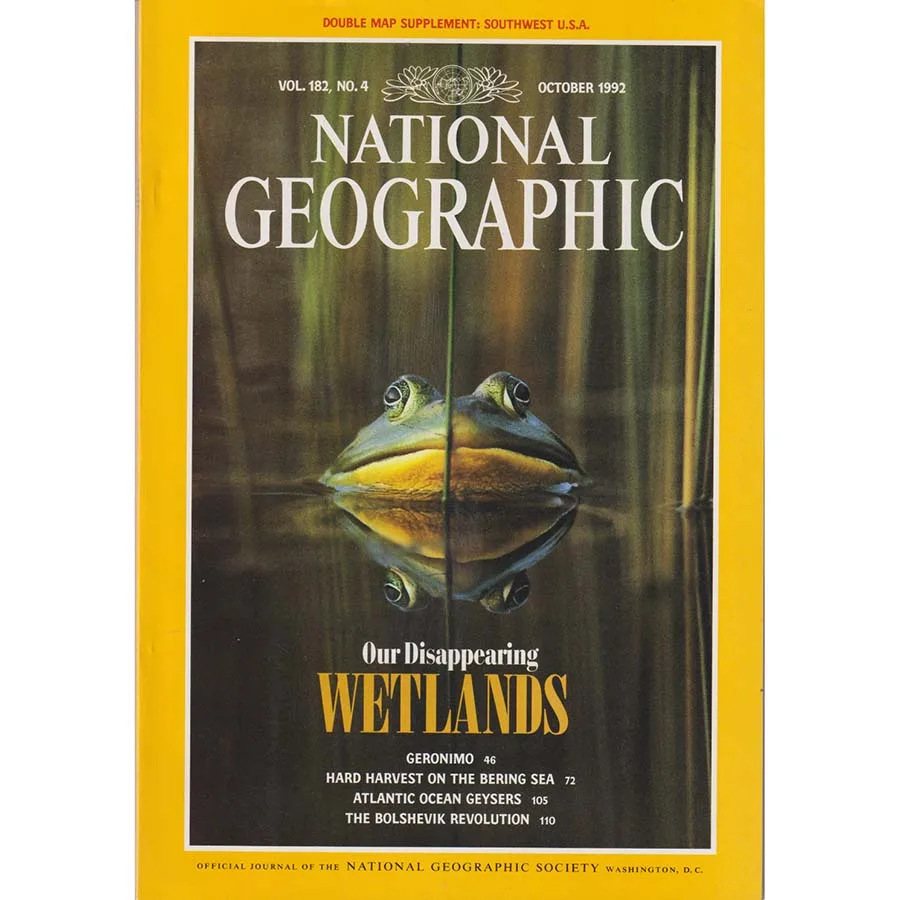
Publisher: National Geographic
Format: Paperback
ISBN: none
National Geographic, October 1992: the issue that emerges from a murky pond, stares directly into your soul with a frog’s unsettling calm, and quietly informs you that your species is very good at destroying things it doesn’t properly understand.
The cover feature is Our Disappearing Wetlands, which sounds like a gentle nature documentary until you realise it’s actually an intervention. Wetlands are the planet’s underrated life-support system: they filter water, blunt floods, store carbon, cradle birds, fish, amphibians, and a thousand invisible ecosystems—and humans, in their infinite wisdom, have historically looked at them and thought, “Yes, but what if this was a car park?” The title doesn’t even pretend to be subtle. It’s basically a headline wearing a lab coat.
And that cover image is perfect: a frog half-submerged, mirrored on the waterline like a natural Rorschach test. It’s cute, yes. It’s also the exact face you imagine nature making when it watches us drain a marsh and then act surprised about flooding. The frog isn’t angry. It’s disappointed. Which is worse.
Inside, expect classic early-90s Nat Geo environmental reporting: lush photographs, clear explanations, and the steady build of facts that makes you realise wetlands aren’t “swamps,” they’re infrastructure. Natural, complex, irreplaceable infrastructure. You’ll get the beauty—reeds, birds, glints of water—alongside the grim maths of loss, pollution, development, and the strange human habit of realising something was valuable only after we’ve bulldozed most of it.
And because National Geographic can’t just do one mood, the rest of the issue is a glorious mix of history, hardship, and deep-ocean weirdness:
-
Geronimo – a reminder that American history is not just dates and flags, but people, resistance, survival, and the way narratives get told (and retold) depending on who’s holding the pen.
-
Hard Harvest on the Bering Sea – cold, dangerous work where the environment doesn’t negotiate. Expect big seas, bigger risks, and the kind of human grit that makes you grateful your job doesn’t involve ice, darkness, and waves that want to eat you.
-
Atlantic Ocean Geysers – because the planet also has underwater plumbing that likes to show off. Strange, beautiful, slightly alien phenomena that make you realise the ocean is still largely a mystery we occasionally poke with instruments.
-
The Bolshevik Revolution – because 1992 was a time of reassessment, when the Soviet story had just cracked open and the world was trying to make sense of what it had been and what it had become. Nat Geo, in its measured way, brings the long view.
And right at the top, like a little bonus for people who love paper geography, there’s the banner: Double Map Supplement: Southwest U.S.A. Which means somewhere in this issue is a fold-out map that will briefly turn you into the kind of person who points at deserts and says, “Ah yes, the drainage basin,” before you spend ten minutes trying to fold it back like it hasn’t been designed as a practical joke.
Condition: Good, which is exactly what you want: still sturdy, readable, and thick with that pre-internet Nat Geo confidence—long articles, serious photography, and the assumption that you can concentrate for more than 30 seconds. Sold by Crappy Old Books, naturally, because the best place to buy a frog-led environmental reckoning plus Geronimo, Bering Sea peril, ocean geysers, Bolshevik history, and a giant Southwest map is a shop that sounds like it’s run by a slightly chaotic treasure-hunter.
If you like your National Geographic with beauty and a point—October 1992 is a cracking pick. Open it up. Let the frog judge you. Then maybe go appreciate a puddle properly.
Keep browsing: See more National Geographic books Other books by National Geographic
