


National Geographic 1992 April
Publisher: National Geographic
Format: Paperback
ISBN: none
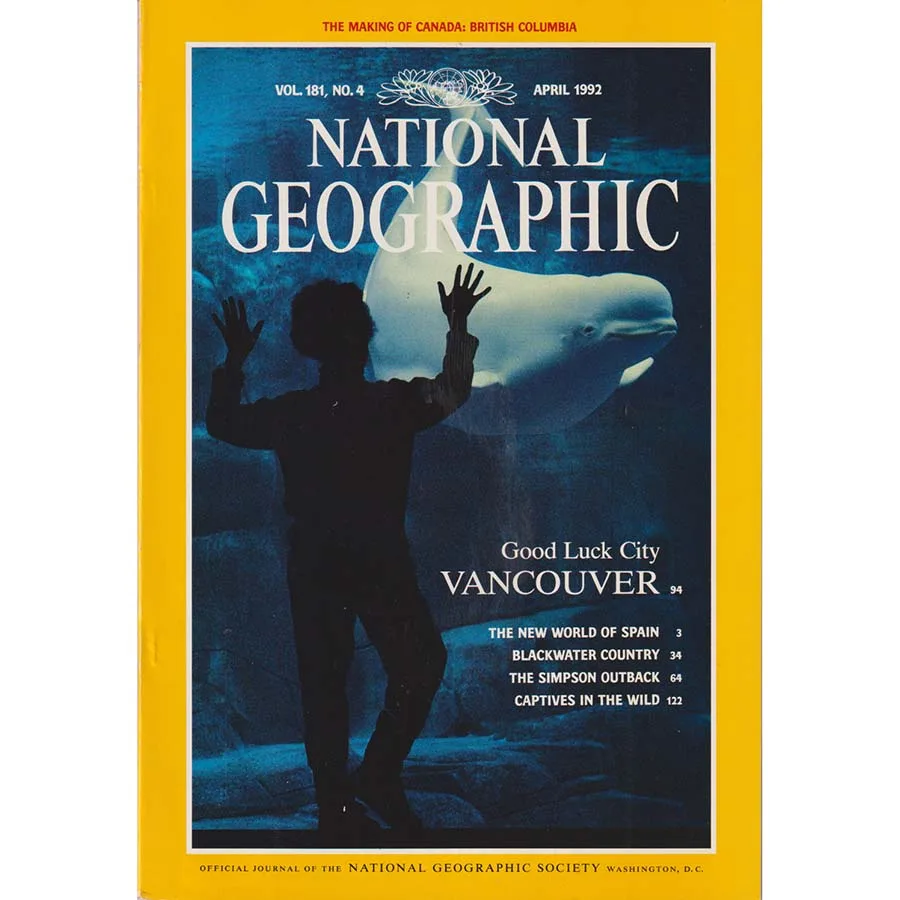
National Geographic, April 1992: the issue that opens with a beluga whale giving you a serene, judgemental side-eye while a silhouetted human presses their hands to the glass like a character in an art film about feelings. And honestly, that’s the perfect mood for a magazine that’s about to take you to Vancouver, Spain, the Australian outback, and somewhere uncomfortably psychological—without once asking if you packed snacks.
The cover story is Good Luck City: Vancouver, which is either a charming nickname or a subtle warning that you’re about to fall in love with a place and start Googling house prices (in 1992 this would involve a phone call and emotional resilience). Nat Geo’s Vancouver is all sea-and-mountain glamour, city planning optimism, and that Pacific Northwest vibe where nature sits right next to your skyscraper and quietly threatens to outshine it. The beluga on the cover feels like a symbolic co-star: beautiful, intelligent, and faintly unimpressed by our urban ambitions.
And because this issue sits under the banner “The Making of Canada: British Columbia”, there’s that extra layer of big landscape narrative—forests, coasts, industry, identity, and the ongoing Canadian talent for making enormous wilderness look both inviting and mildly intimidating.
Then the magazine does what it always does: whips the rug out from under your expectations with a supporting cast that reads like a fever dream itinerary:
-
The New World of Spain – which sounds like a tourist board slogan until you remember Nat Geo will use it to talk about history, culture, and the kind of national reinvention that comes with deep roots and complicated politics. 1992 is also a big “Spain on the world stage” moment, so there’s a sense of a country polishing its story for an international audience.
-
Blackwater Country – instantly atmospheric. The phrase alone smells like peat, tannins, and old maps. Expect wetlands, hidden ecosystems, and a reminder that “empty” landscapes are often the busiest, most alive ones—just not in ways humans notice quickly.
-
The Simpson Outback – because Australia always shows up in Nat Geo to prove that the planet contains places that are not interested in your comfort. Vast, hot, stunning, and the sort of terrain that makes you respect shade as a concept.
-
Captives in the Wild – which is the quietly unsettling entry on the menu. Nat Geo can do wonder, but it also does hard questions: ethics, human behaviour, animals, and the blurred line between “care” and “control.” This is the sort of feature that starts as curiosity and ends with you staring into the middle distance, rethinking your childhood zoo memories.
Condition: Good, meaning it’s still very readable and still has that early-90s National Geographic heft: thick pages, serious photojournalism, and the confidence to assume you’ll sit with a long article rather than demand a summary in twelve seconds. Sold by Crappy Old Books, naturally—because the best place to find a beluga-fronted Vancouver love letter plus Spanish history, swampy mystery, outback intensity, and ethical unease is from a seller whose name suggests you’ll also come away with a random atlas and a faintly cursed paperback.
If you want a single issue that captures what Nat Geo does best—beauty with brains, travel with context, and at least one story that gently ruins your day in a productive way—April 1992 is a cracking pick. The whale is waiting. Try not to be judged.
Keep browsing: See more National Geographic books Other books by National Geographic
