


National Geographic 1992 January
Publisher: National Geographic
Format: Paperback
ISBN: none
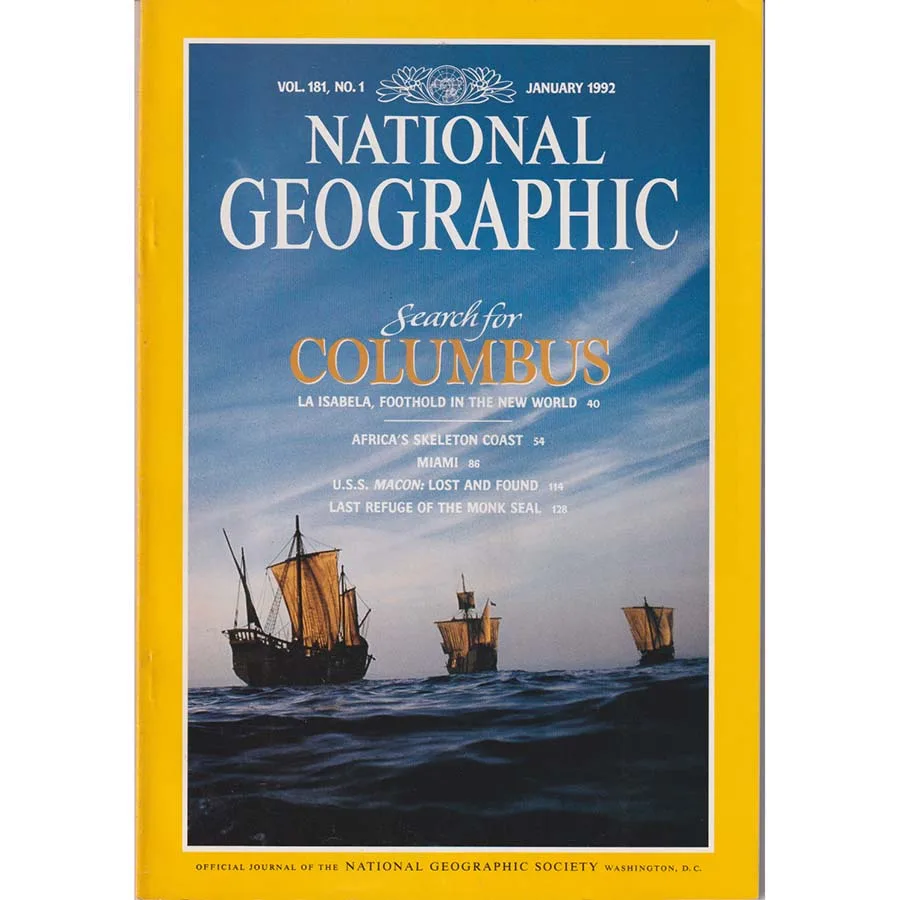
National Geographic, January 1992: the issue that rolls in on a cinematic sea, sails billowing, and announces—like a narrator with a perfectly trained voice—that we are once again going to argue about Columbus. Politely. With photographs. Possibly with a trowel.
The cover line Search for Columbus has that very National Geographic confidence: not “a quick look,” not “some thoughts,” but a full-on search—because if there’s one thing Nat Geo loves, it’s taking a famous historical story and treating it like an unsolved case file. The subhead, La Isabela, Foothold in the New World, makes it sound like an archaeological footnote. In reality it’s the kind of place where history stops being abstract and becomes mud, bones, broken pottery, and the uncomfortable truth that “discovery” is often just a nicer word for “arrival with consequences.”
And that’s the delicious irony of this issue: the cover is all romance—ships on a wide ocean, golden light, epic horizons—while the actual subject is messy, human, and morally complicated. 1992 was the big quincentenary moment, after all: a time when a lot of people were reassessing the story, the celebration, the language, and what it left out. National Geographic leans into the archaeology and geography—the where, the how, the evidence—while the modern reader can’t help hearing the second track playing underneath: whose world was it, what changed, and who paid.
But don’t worry: Nat Geo never lets you sit in one topic for too long before it whisks you somewhere else entirely, like an overly enthusiastic travel agent with a global attention span.
You also get:
-
Africa’s Skeleton Coast – which sounds like a heavy metal album and reads like a landscape that actively resents human visitors. Expect shipwrecks, desert meeting ocean, and the kind of eerie beauty that makes you grateful your commute doesn’t involve fog, dunes, and certain doom.
-
Miami – a pivot from ancient sails to neon modernity, where the story becomes culture, migration, identity, and a city that feels like it’s perpetually being invented in real time.
-
U.S.S. Macon: Lost and Found – because humans cannot resist recovering lost machines from water. It’s practically a species trait. Add aviation history, salvage drama, and the satisfying feeling of “we found it!” applied to something that was perfectly happy not being found.
-
Last Refuge of the Monk Seal – the quiet gut-punch, because no Nat Geo issue is complete without at least one feature that makes you love an animal and then worry about it. It’s nature writing with a conservation edge, delivered in that early-90s tone of “we still have time… if we stop being ridiculous.”
Condition: Good, meaning it’s still very readable and still has that early-90s Nat Geo heft—thick pages, big photo spreads, and the unshakeable belief that you’ll happily spend an evening with long articles instead of blinking at a screen. Sold by Crappy Old Books, naturally, because the best place to buy a glossy 1992 time capsule about Columbus, desert coasts, Miami, a lost airship, and endangered seals is from a seller whose name suggests it’s powered by dust, luck, and surprise treasure.
If you like your January issues with big oceans, bigger history, and a side order of shipwreck vibes—this one’s a keeper. Open it up, let the sails fill, and prepare to be quietly educated in the most old-school way possible.
Keep browsing: See more National Geographic books Other books by National Geographic
