


National Geographic 1992 February
Publisher: National Geographic
Format: Paperback
ISBN: none
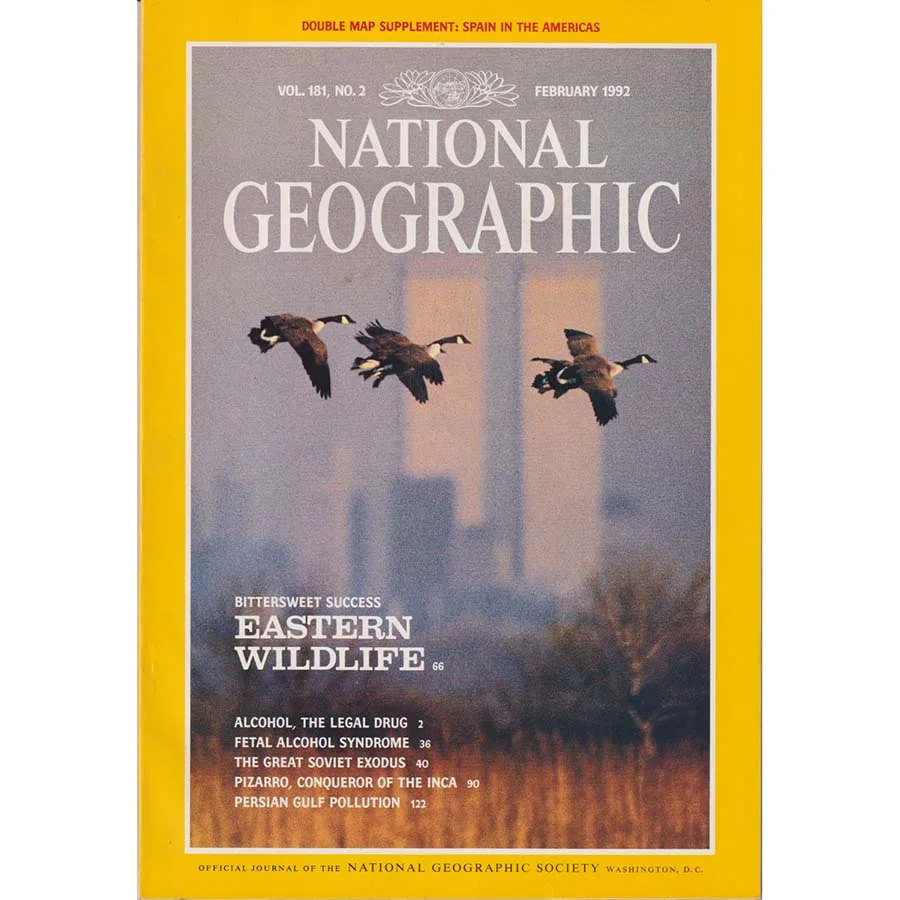
National Geographic, February 1992: the issue that floats in on a soft winter sky, gives you a flock of geese and a misty city skyline, and then immediately hits you with the kind of topics that make you put your tea down and mutter, “Right then.”
The cover story is Bittersweet Success: Eastern Wildlife—a title that sounds like a gentle nature ramble until you realise it’s basically about the complicated bargain of conservation in a landscape where humans have been rearranging everything for centuries. The cover image nails that mood perfectly: wildlife in motion, urban silhouettes lurking in the background like a reminder that nature doesn’t get to exist “somewhere else” any more. It’s beautiful, but it’s also a little melancholy—geese flying past the world we built, as if they’re politely ignoring our nonsense.
And because this is early-90s National Geographic—still thick, still serious, still unafraid of big subjects—the contents are a proper mixed bag of wonder and “oh, that’s grim”:
-
Alcohol, the Legal Drug and Fetal Alcohol Syndrome – Nat Geo doing that sober, investigative thing it does so well: taking something ordinary and socially accepted, then calmly laying out the human cost. It’s the sort of reportage that doesn’t shout, it just stacks the facts until you can’t look away.
-
The Great Soviet Exodus – a very 1992 headline, dripping with the feeling of a world rearranging itself in real time. Borders, identities, migrations, uncertainty—history mid-shift, captured while the dust is still in the air.
-
Pizarro, Conqueror of the Inca – the kind of historical deep dive that feels like an adventure story until the moral bill arrives. Nat Geo in this era often has that “exploration” tone, but you can also feel the darker underside: conquest, collapse, and the uncomfortable realities behind famous names.
-
Persian Gulf Pollution – because the early 90s were also the moment a lot of environmental consequences stopped being abstract and started being photographed in colour. Expect a hard look at what war and industry leave behind when the headlines move on.
And then—like a little gift for your inner cartography gremlin—this copy includes the “Spain in the Americas” pull-out poster map. Which is National Geographic’s way of saying: “Here, have a huge, foldable diagram of imperial reach, trade routes, and history’s long shadow.” It’s gorgeous, it’s educational, and it will take you at least three attempts to fold it back properly, during which you will learn humility.
Condition: Good, meaning it’s still very readable and still has that early-90s Nat Geo heft: big photographs, long articles, and absolutely no concern for your modern attention span. Sold by Crappy Old Books, naturally—because where else would you find geese, geopolitics, environmental fallout, conquistadors, public health, and a massive map supplement in one satisfying yellow rectangle?
If you like your National Geographic with real range—nature that’s not just pretty, history that’s not just heroic, and a pull-out map that turns your living room into a planning room—February 1992 is a cracking pick.
Keep browsing: See more National Geographic books Other books by National Geographic
