


National Geographic 1993 September
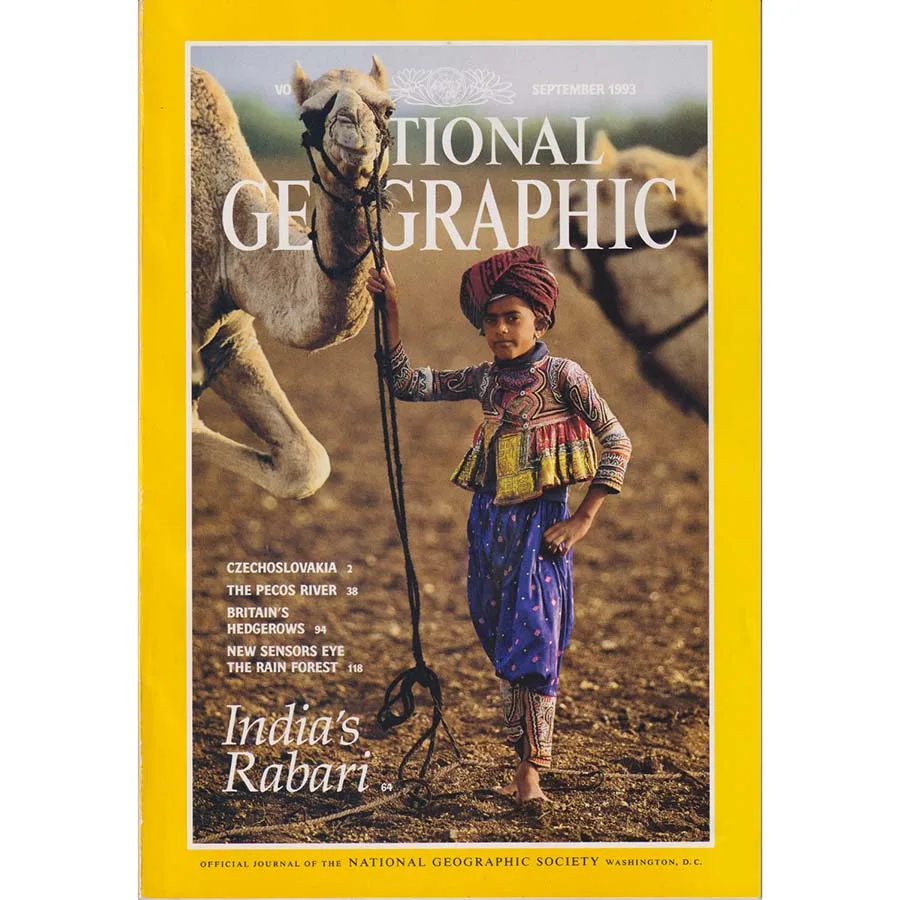
Publisher: National Geographic
Format: Paperback
ISBN: none
National Geographic, September 1993: the issue that turns up in its famous yellow frame looking calm, sunlit, and unhurried—then quietly pulls you into a world where people, animals, politics, rivers, and hedgerows all matter a lot more than you realised at first glance.
The cover story, India’s Rabari, is classic Nat Geo: a focus on a community that lives with the land in a way that feels both ancient and urgently modern. The cover image does half the storytelling on its own—bright textile patterns, bare feet on dry earth, and a camel standing there like it owns the horizon (which, to be fair, it probably does). It’s the sort of photograph that makes you pause because it’s simultaneously ordinary and astonishing: daily life, but on a scale of landscape and tradition most of us only ever experience through pages like these.
Inside, expect the Rabari world to unfold as a mix of movement and meaning: herding, survival, craft, identity, and the quiet logistics of living in places where “infrastructure” isn’t a given and weather has a vote. It’s a reminder that “culture” isn’t something you visit like a museum; it’s work, routine, choices, and adaptation—sometimes with a camel attached.
And because National Geographic in 1993 was never content to be just one thing, the rest of the issue is a gloriously eclectic world tour:
-
Czechoslovakia – a title that, in 1993, comes with that transitional electricity: borders shifting, identities renegotiated, history moving under people’s feet. It’s Europe in motion, captured at the moment it’s rearranging itself.
-
The Pecos River – because no matter how big the geopolitical shifts are, rivers keep doing their thing, carving landscapes and human lives into the same long story. Expect scenery, ecology, and that Nat Geo knack for making a stretch of water feel like a character.
-
Britain’s Hedgerows – yes, hedgerows. And if you’re tempted to yawn, Nat Geo will gently trap you with facts until you admit they’re basically living infrastructure: boundaries, habitats, history, and biodiversity disguised as something you drive past without thinking. It’s the sort of feature that makes you look at the English countryside and realise it’s been edited, shaped, and maintained like a vast, green manuscript.
-
New Sensors Eye the Rain Forest – a deliciously early-90s note of “the future is arriving” via technology. Monitoring forests from above, reading the canopy like data, using new tools to see what was previously invisible. It’s optimism with a faint edge of anxiety: we’re getting better at watching the planet… because we’ve got reasons to.
Condition: Good, which is exactly right for a September 1993 issue: sturdy, readable, and still full of that pre-internet confidence—long articles, lush photography, and the expectation that you’ll happily spend time with it rather than skimming it like a headline. Sold by Crappy Old Books, naturally, because the best way to acquire a glossy portal to India’s pastoral life, a shifting Europe, an American river, British hedges, and rainforest sensors is from a seller whose name suggests you’ll find treasure under a slightly crooked stack of magazines.
If you like your National Geographic thoughtful, tactile, and quietly wide-ranging—September 1993 is a beauty. Come for the camel. Stay for the hedgerows. Leave with the unsettling sense that everything you’ve been ignoring has a story.
Keep browsing: See more National Geographic books Other books by National Geographic
