


National Geographic 1985 August
Publisher: National Geographic
Format: Paperback
ISBN: none
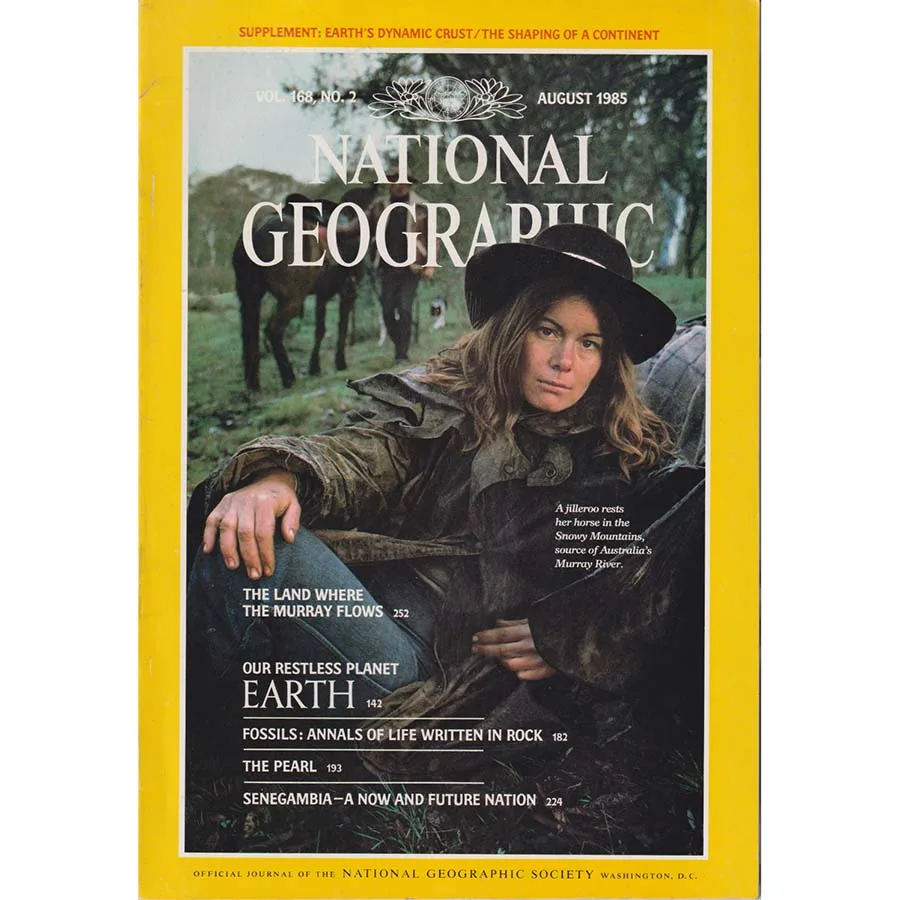
August 1985, and National Geographic is serving peak “I have lived a life outdoors and the weather has opinions” energy. The cover alone looks like it should come with the faint smell of damp canvas and sensible boots: a woman in a wide-brimmed hat, casually reclining like a frontier poet, while horses mooch in the background and the landscape quietly suggests you might not make it if you forget a jacket. It’s rugged, cinematic, and extremely 1980s Geographic — the era when exploration still came with film cameras, patience, and a hearty tolerance for mud.
Front and centre is The Land Where the Murray Flows, which sounds gentle and pastoral until you remember rivers are basically long, moving arguments between geography, climate, and human ambition. Expect Australia served in that classic Geographic style: wide horizons, big skies, quietly heroic everyday lives, and the sort of writing that makes you feel like you should be able to identify birds by silhouette (you cannot) and mend a fence with wire (you definitely cannot). It’s the kind of feature that makes you romanticise distance, even if your own idea of a journey is walking to the shops.
But the true comedy of National Geographic is its refusal to stick to one vibe. Because right under “river country” it drops: Our Restless Planet — EARTH. Not “geology,” not “rocks,” not “a few interesting formations.” Just EARTH, in giant letters, like the magazine has decided you’re ready for the entire planet explained to you in one sitting. There’s something wonderfully audacious about that — the print equivalent of someone saying, “So, about tectonic plates… let’s start at the beginning of time.” And this issue even boasts a supplement up top about the planet’s dynamic crust and shaping a continent, because apparently you weren’t busy enough.
Then it keeps going. Fossils: Annals of Life Written in Rock — which is both poetic and slightly intimidating, because it implies you should be able to read stone like a diary. The Pearl — which sounds delicate and glamorous until you remember it involves oysters doing slow, stubborn chemistry in the sea. And Senegambia — A Now and Future Nation, because in between rivers, tectonics, and fossils, the magazine also wants you to think seriously about nationhood, history, and the future. It’s a whole educational buffet: pastoral adventure, deep time, geopolitics, and marine jewellery, all delivered with calm authority and excellent photography.
This is the kind of issue that makes you feel smarter simply by owning it. You don’t even have to read it (though you will). Just having it within arm’s reach suggests you’re the sort of person who casually contemplates plate boundaries while making tea.
Condition is Good, which means this copy has survived the decades with respectable dignity — readable, intact, and still capable of making your coffee table look like it has a postgraduate degree. No ISBN because magazines don’t submit to ordinary book rules; they roam free, stapled and proud. Sold by Crappy Old Books, which feels exactly right: a slightly timeworn portal to 1985, when the world was still being explained in glossy pages and the planet felt both enormous and knowable if you just read hard enough.
Perfect for collectors, geology nerds, Australia romantics, fossil-fanciers, and anyone who wants a single magazine to take them from muddy riverbanks to the molten mechanics of the Earth — without leaving the sofa.
Keep browsing: See more National Geographic books Other books by National Geographic
