


National Geographic 1997 April
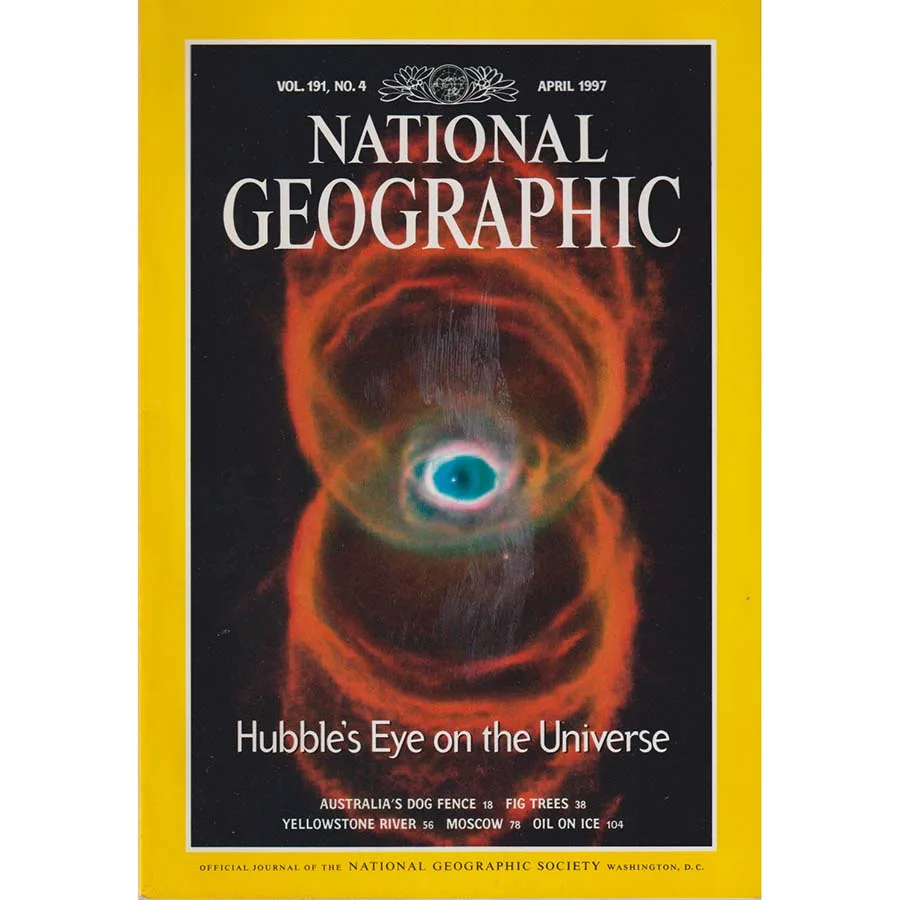
Publisher: National Geographic
Format: Paperback
ISBN: none
Introducing National Geographic, April 1997 — a yellow-bordered portal to the late-90s, when the future looked shiny, science felt heroic, and the universe politely agreed to pose for magazine covers.
And what a cover. “Hubble’s Eye on the Universe” splashed across a cosmic image that looks like a flaming iris staring straight into your soul. It’s equal parts astronomy and album art. You don’t read this issue so much as get gently judged by the infinite. The message is clear: you are small, the universe is huge, and your troubles are (respectfully) a rounding error.
Inside, it’s classic National Geographic: one moment you’re contemplating galaxies and the cold grandeur of space, the next you’re right back on Earth with mud on your boots and a notebook full of facts. It’s the magazine equivalent of a friend who says, “Let’s keep it chill,” then drags you into a lecture, a safari, and a geopolitical briefing — and somehow you’re grateful.
This issue’s cover teasers are a wonderfully eclectic 1997 mixtape:
-
Australia’s Dog Fence — the most aggressively practical piece of engineering you’ve ever seen described with reverence. A fence so long it feels like a national mood.
-
Fig trees — nature’s overachievers: part plant, part apartment block, part mythological entity.
-
Yellowstone River — sweeping landscapes, American grandeur, and the quiet suggestion that you should go outside more.
-
Moscow — that post-Cold-War fascination with a city reinventing itself in real time, equal parts history and transition.
-
Oil on ice — a phrase that sounds like a cocktail but is, of course, something much more ominous. Because Nat Geo never lets you drift too far into wonder without reminding you the planet is also fragile and complicated.
But the headline act is Hubble — the space telescope that, by 1997, had become the world’s most expensive and effective proof that the universe is both beautiful and slightly unsettling. This is the era when “space photos” went from fuzzy dots to jaw-dropping cosmic architecture. The kind of images that make you whisper “wow” and immediately forget what you came into the room for.
No ISBN (because magazines refuse to be domesticated), Condition: Good, and sold by Crappy Old Books — which feels exactly right for a publication that’s survived the CD-ROM age and still looks smugly magnificent on a shelf. Expect honest wear: a bit of scuffing, a bit of age, and that satisfying old-paper presence that says, “I have been handled by curious humans.”
Perfect for collectors, space nerds, or anyone who wants a single issue that can take you from the edge of the universe to a fence in Australia without even pausing for breath. April 1997: come for the cosmic eye, stay for the gentle existential crisis — and the fig trees.
Keep browsing: See more National Geographic books Other books by National Geographic
