


National Geographic 2000 March
Publisher: National Geographic
Format: Paperback
ISBN: none
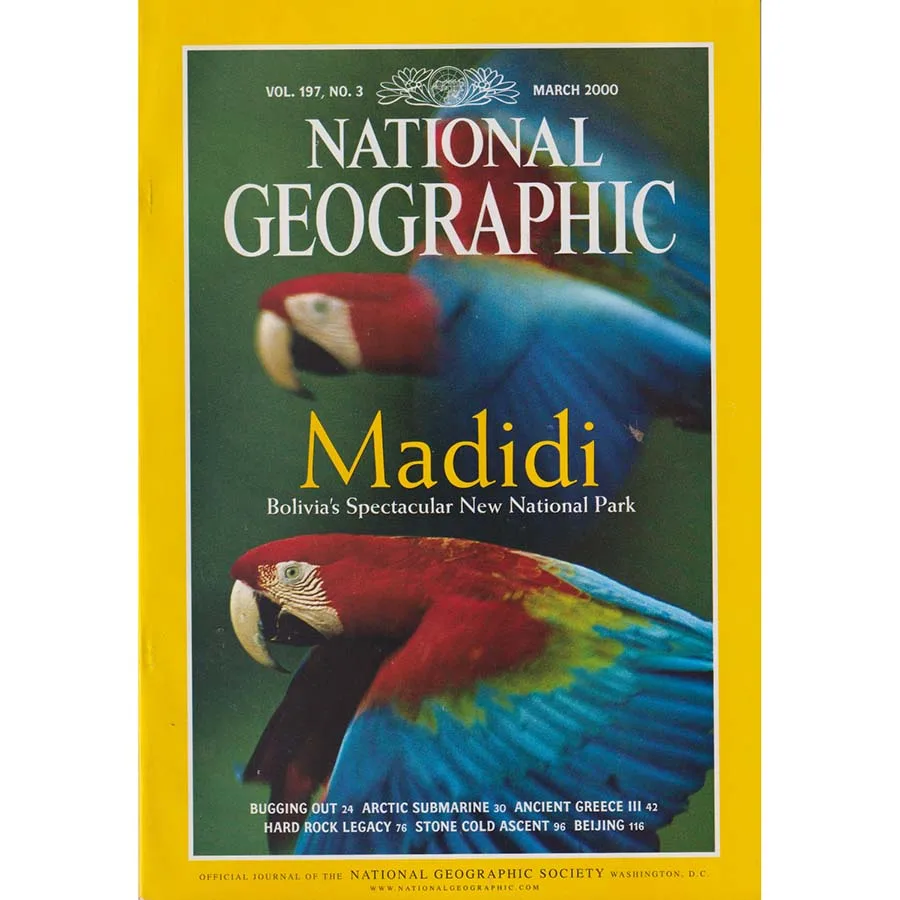
National Geographic – March 2000 is the issue that turns up wearing tropical plumage and the serene confidence of something that has never once had to worry about clashing colours. Two scarlet macaws sweep across the cover like the magazine is saying, “Yes, it’s educational, but it’s also a flex.” And then, right there in the middle, the word Madidi—Bolivia’s spectacular new national park—announced with the kind of calm grandeur usually reserved for emperors, comets, or a very expensive kitchen island.
Inside, you get classic turn-of-the-millennium Nat Geo energy: wide-eyed wonder, tidy authority, and that reassuring sense that the world is complicated, but someone has brought a clipboard and will explain it to you in warm, well-lit prose. This is the era when the planet still felt “discoverable” in magazine form—when you could genuinely believe that flipping pages might count as travel, and that knowledge came bound in glossy paper with a yellow frame like a polite warning sign: Caution: Curiosity Inside.
Madidi is the headline event, of course: rainforest grandeur, biodiversity doing its loudest work, and the sort of lush abundance that makes your local park bench look like a personal failure. The macaws are not here to be cute. They’re here to remind you that nature is simultaneously beautiful, chaotic, and absolutely uninterested in your timetable.
Then you glance down the cover list and realise March 2000 is also a buffet. One moment: tropical paradise. Next: BUGGING OUT (because we all needed an insect-based existential crisis). Then an ARCTIC SUBMARINE (for when you want your wonder refrigerated and pressurised). ANCIENT GREECE (so your brain can wear a toga for a bit). HARD ROCK LEGACY (because of course there’s time for a little guitar-shaped anthropology). And BEIJING—because this magazine refuses to choose between “remote jungle” and “global metropolis” like a normal publication. It’s essentially five different documentaries in a trench coat.
It’s also a perfect little time capsule of 2000: before everything became a tab, a feed, a notification, a ping. Here, the adventure is linear. You start at page one like a responsible adult, and by page fifty you’re somehow deeply invested in a place you couldn’t have pointed to ten minutes ago. It’s analogue wandering, with just enough earnestness to make you feel slightly improved as a person.
Condition: Good, which is exactly right for Crappy Old Books: a copy that’s been handled, read, maybe left open face-down during a cup of tea, and lived to tell the tale. The kind of magazine that still works as a travel plan, a science lesson, and a reminder that the world is outrageously vivid—and you’ve been indoors far too long.
Keep browsing: See more National Geographic books Other books by National Geographic
