


National Geographic 1986 June
Publisher: National Geographic
Format: Paperback
ISBN: none
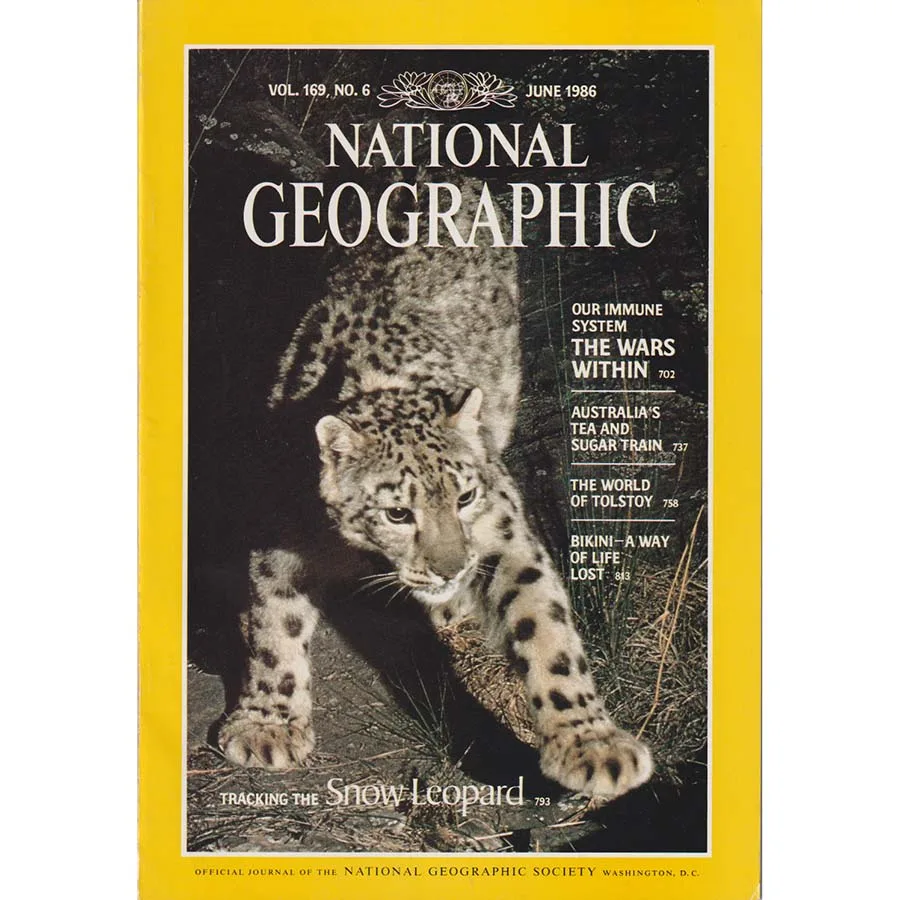
National Geographic, June 1986, turns up in its famous yellow frame looking like it’s about to sneak into your living room and softly rearrange your sense of scale. The cover is a perfect little ambush: a snow leopard prowls out of the dark, paws extended, eyes locked, every spot and whisker saying I was built for mountains you can’t even pronounce. The headline—“Tracking the Snow Leopard”—sounds gentle, almost polite, like you’re going on a nature walk. The irony, obviously, is that the snow leopard is the one doing the tracking, and you are a warm, slow, brightly lit creature reading about it indoors.
This is peak 1980s Nat Geo: grand wildlife photography paired with an earnest, slightly thrilling belief that if you follow enough pawprints and interview enough scientists, the world will reveal its secrets. Expect a proper expedition narrative—high altitude, thin air, patient observation, and the kind of quiet suspense where the main drama is whether you’ll see the animal at all. Snow leopards are famous for being present without being seen, like an elegant ghost with excellent camouflage and no interest in your schedule. The magazine tries to meet them on their terms: tracks in snow, blurred glimpses, evidence more than spectacle. You don’t just get a cat. You get the idea of a cat that refuses to be content.
Then the issue pulls its classic move: while you’re still thinking about Himalayan ridgelines, it pivots to your own body with a feature titled “Our Immune System: The Wars Within.” Which is an incredible bit of editorial whiplash. One moment you’re imagining icy cliffs and silent paws; the next you’re reminded there is an entire conflict zone inside you, running 24/7, staffed by microscopic workers who never get a day off and never unionise. It’s both comforting and horrifying: you’re protected by an army you didn’t hire, and it occasionally gets confused and attacks the furniture.
And because National Geographic has never believed in doing one mood at a time, you also get Australia’s tea and sugar train (a phrase that sounds like a children’s book but is probably about industry, landscape, and the romance of logistics), the world of Tolstoy (because why not add Russian literature to your wildlife-and-immunology stew), and Bikini—“a way of life lost” (a sobering reminder that paradise can be renamed, repurposed, and permanently altered by history’s loudest decisions).
So yes, June 1986 is a glorious mixed bag: a stealth cat in the dark, a microscopic war in your blood, a train hauling sweetness across Australia, Tolstoy looming in the background like a moral weather system, and an island story that lands with a quiet punch. The unspoken theme is: everything is connected, and almost nothing is simple.
Condition: Good, sold by Crappy Old Books—which is exactly where a serious, globe-spanning, beautifully produced magazine should end up, frankly. Because the best kind of knowledge is the kind you stumble across accidentally, for a modest price, and then spend the evening reading while occasionally glancing over your shoulder… just in case a snow leopard has learned how to use door handles.
Keep browsing: See more National Geographic books Other books by National Geographic
