


National Geographic 1996 November
Publisher: National Geographic
Format: Paperback
ISBN: none
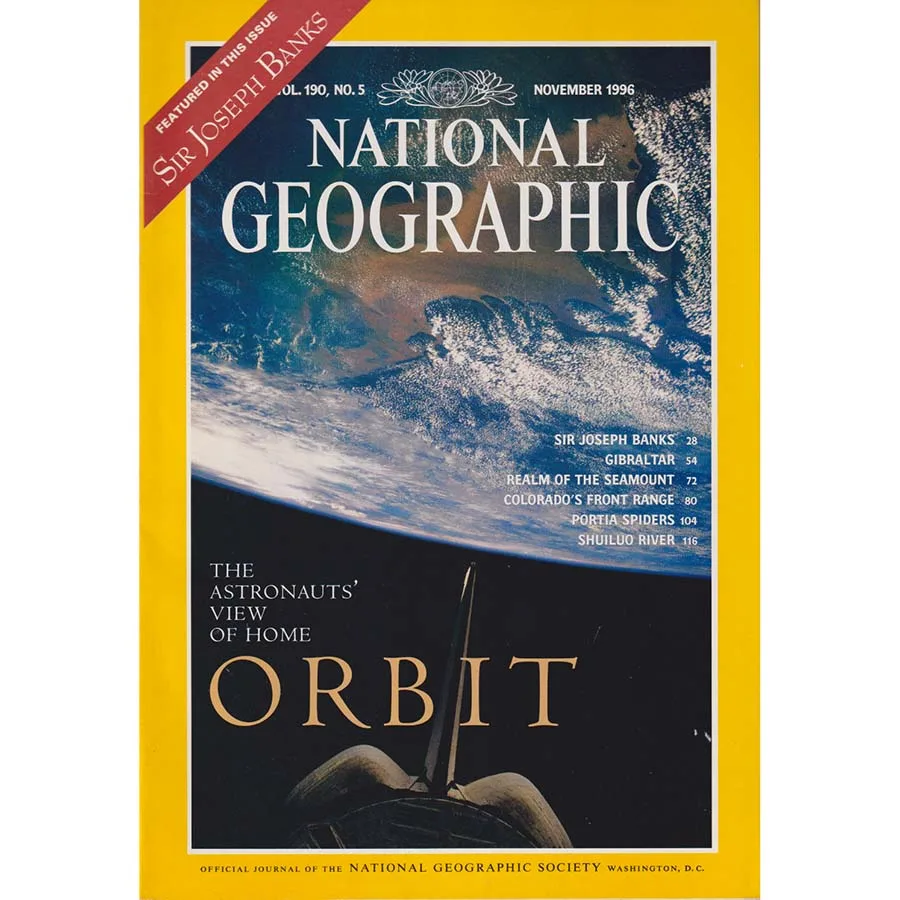
National Geographic, November 1996 turns up in its yellow frame looking like it’s about to do something very National Geographic indeed: make you feel small, inspired, and slightly guilty about how little you’ve seen. The cover is pure cosmic swagger—Earth’s curve glowing at the top, a spacecraft lurking at the bottom, and the word ORBIT set in big, tasteful letters like it’s a luxury destination you could book if you just found the right travel agent and a spare few million.
The main feature, “The Astronauts’ View of Home,” is that classic Nat Geo sweet spot where science becomes poetry without ever raising its voice. You get the clinical marvel of spaceflight—the machinery, the logistics, the disciplined competence—paired with that soft, existential punch of seeing Earth as a fragile blue system floating in black nothingness. It’s the kind of article that makes you want to recycle more and call your mother. It also has the very 1996 charm of being “the future” in an era when space still felt like a grand, expensive shared dream rather than a tech-bro playground.
And then, because this magazine cannot resist being five different magazines at once, it piles on a spectacularly eclectic lineup beneath the space glamour. There’s Sir Joseph Banks (because no issue is complete without an 18th-century polymath turning up to make you feel lazy), Gibraltar (a rock with a geopolitics addiction), Realm of the Seamount (underwater mountains—because apparently the ocean needed its own secret topography), Colorado’s Front Range (big American landscape, big American scale), Portia spiders (tiny, clever, slightly unsettling geniuses of the arachnid world), and the Shuiluo River (a reminder that entire cultures and places can be as remote to you as low Earth orbit, even while still on the same planet).
The irony is delicious: you open the issue for orbit—space! the ultimate elsewhere!—and Nat Geo immediately drags you back down into the extraordinary strangeness of Earth. It’s basically saying: yes, look at the planet from space, absolutely… but also look at this spider that can outthink you, this underwater mountain range you’ve never heard of, and this river valley where life has its own logic. The message is gently relentless: you don’t need to leave Earth to find wonder. You just need to pay attention. (And preferably subscribe, but we’ll gloss over that.)
Condition: Good, which is perfect—this is the kind of issue that should feel like it’s been handled, reread, and left on a coffee table as a quiet flex. Sold by Crappy Old Books, an appropriately humble portal through which you can acquire: the view from orbit, an Enlightenment scientist, a geopolitical rock, deep-ocean geology, Colorado scenery, and weaponised spiders. All for less than the cost of a rocket launch.
Keep browsing: See more National Geographic books Other books by National Geographic
