


National Geographic 1986 April
Publisher: National Geographic
Format: Paperback
ISBN: none
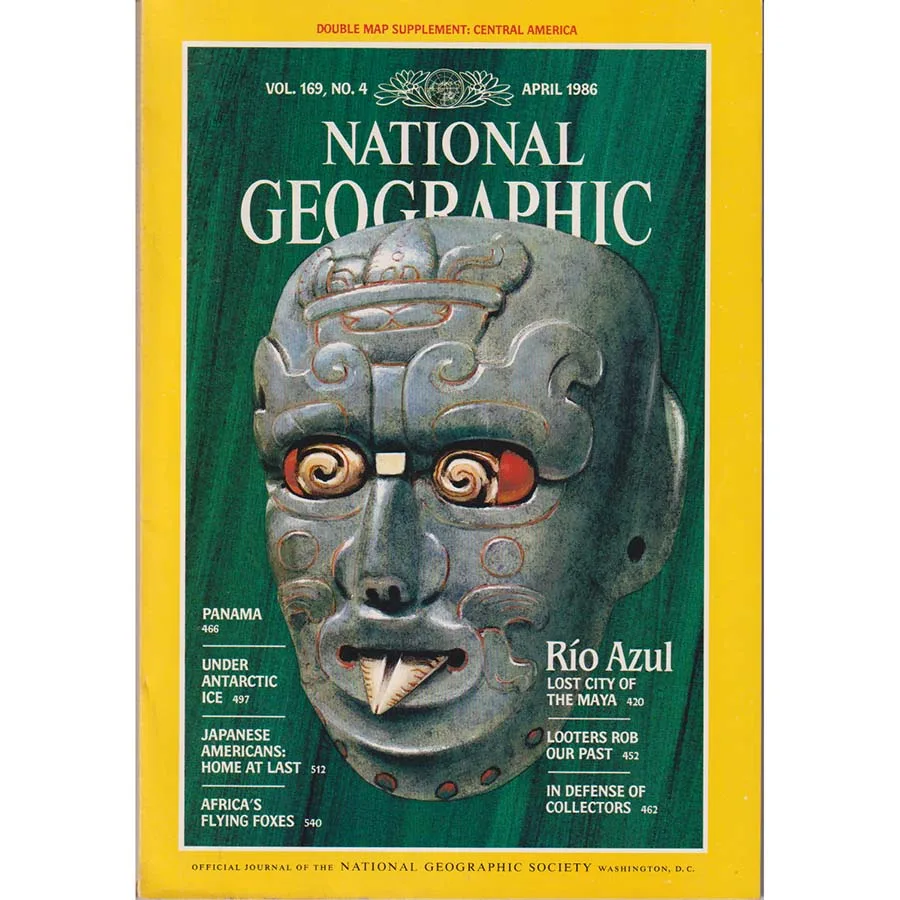
National Geographic, April 1986 shows up in its famous yellow frame looking like it’s about to ask you an unsettling question in a calm voice. The cover is dominated by a carved mask—cool grey-green, swirling eyes, a little fang peeking out—staring straight through you with the patient confidence of something that has outlived empires. The headline says “Río Azul: Lost City of the Maya”, but the vibe says: you are absolutely not ready for how deep this rabbit hole goes.
This is peak mid-80s Nat Geo: lush, authoritative, and delightfully unhurried. It takes you to Río Azul, into the jungle and into the archaeology—stone, glyphs, tombs, fragments of lives preserved by accident and soil. It’s the kind of feature that makes you want to clear a table and start drawing maps with a pencil like you’re about to mount an expedition yourself. (You won’t. But you’ll feel like you could.) And, as always, it’s not just about “ancient ruins”; it’s about people—trade, power, ritual, daily life—made vivid through that glossy, patient, slightly romantic Nat Geo lens.
Then, like a magician pulling extra scarves from a sleeve, the issue broadens out into its classic world-spanning mix. You’ve got Panama (canals, crossroads, geopolitics with humidity), Under Antarctic Ice (because even when you’re in the Maya lowlands, Nat Geo insists you also go to the bottom of the world), Japanese Americans: Home at Last (history and belonging told in human scale), and Africa’s Flying Foxes (because nothing says “relaxing read” like learning that huge bats commute in the sky like a living weather system).
And there’s an extra treat for the print-age connoisseur: this copy includes the “Central America Past and Present” poster. That’s right—your magazine comes with an unfoldable wall-sized reminder that geography isn’t just places, it’s layers. Past and present literally on the same sheet, ready to be spread across your floor like a planning document for a very earnest, very doomed attempt to “just understand the region quickly.” (The poster will help. Your hubris will not.)
The irony, of course, is that while the issue is obsessed with what’s been lost, it also contains a whole side-feature about looters robbing our past and the defence of collectors—a very 1986 argument served with the magazine’s trademark steady tone. It’s the kind of debate that feels timeless: who owns history, who gets to keep it, and what happens when curiosity meets money and weak laws.
Condition: Good, which is exactly what you want: a magazine that’s been around, still solid, still ready to pull you into jungles, ice sheets, canals, diaspora stories, and bat-filled skies. Sold by Crappy Old Books, which is a perfect punchline—because this is an issue with a lost Maya city and a bonus Central America poster, acquired from a place that sounds like it might also sell you a slightly damp atlas and a VHS documentary narrated by someone very serious.
Keep browsing: See more National Geographic books Other books by National Geographic
