


National Geographic 1996 June
Publisher: National Geographic
Format: Paperback
ISBN: none
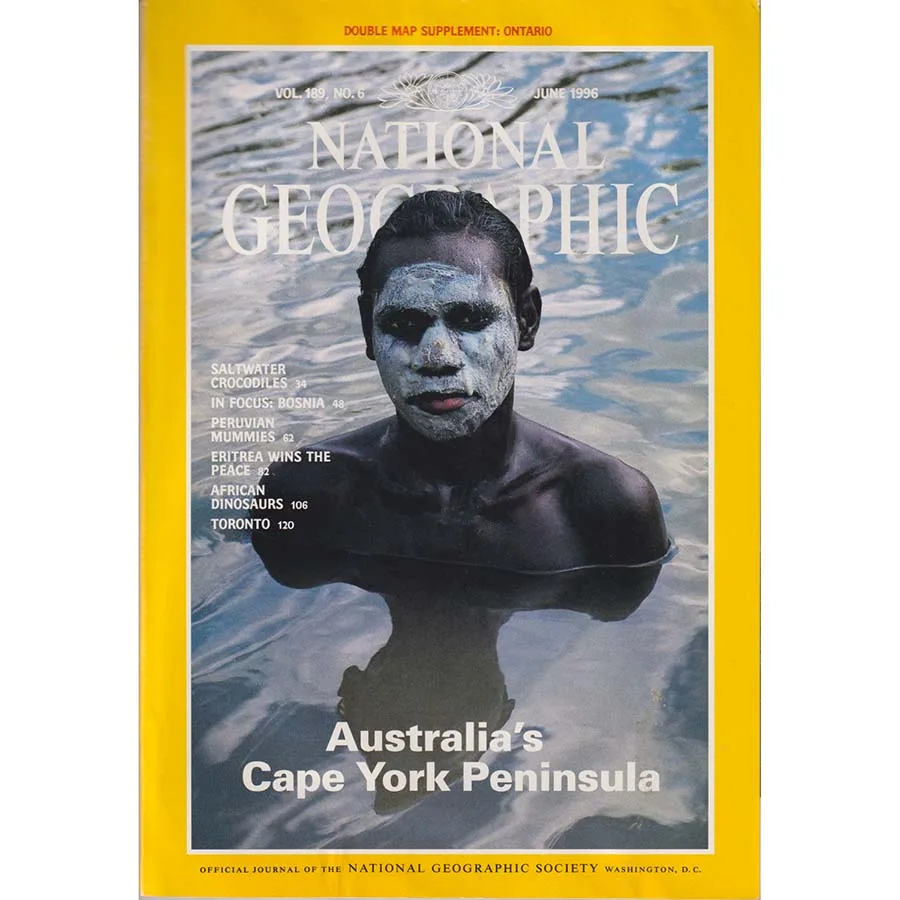
National Geographic, June 1996 turns up looking like it’s about to tell you a secret, and then immediately locks eyes with you from the water. The cover image is pure Nat Geo mood: a person half-submerged, face painted, expression unreadable, the whole scene hovering between documentary realism and “this might be the opening shot of a very thoughtful film.” The headline grounds it: Australia’s Cape York Peninsula—a place that sounds remote even when you say it aloud, like geography itself is testing your commitment.
Inside, you get that classic National Geographic long-form immersion: big landscapes, deep time, and human stories woven into a region that feels both ancient and very much alive. Cape York is presented not as a “destination” but as an entire world of coastlines, rivers, monsoon rhythms, wildlife, and communities—one of those places where the map looks empty until you realise you’ve been using the wrong definition of “busy.”
And because it’s 1996, the issue is also gloriously eclectic—Nat Geo doing its monthly trick of stacking the whole planet into one magazine like it’s perfectly normal. There are saltwater crocodiles (because “Australia” without a prehistoric reptile cameo would be suspicious), an In Focus: Bosnia segment (sharp, recent history with real consequences), Peruvian mummies (the dead, still doing PR for archaeology), Eritrea wins the peace (a line that reads with all the bittersweet hope of the era), African dinosaurs (because you can’t go a month without deep time), and Toronto (a city feature that arrives like a polite handshake after crocodiles, conflict, and mummified ancestors).
And then—best of all for the tactile-print connoisseur—this copy includes a pull-out poster on the making of Canada. That’s right: not just a poster, but a map-and-history flex you can physically unfold like a ceremonial scroll. There’s something wonderfully ironic about it: you buy an issue about the tip of Australia and it comes with a bonus visual essay on Canada, because National Geographic has always had the energy of a friend who can’t tell a story without also grabbing a large sheet of paper and saying, “Wait, wait, let me show you.”
Condition: Good, which is exactly what you want: solid, readable, ready for another lap around the world from your sofa. Sold by Crappy Old Books, an appropriately unglamorous portal through which you can acquire: remote Australia, Balkan aftermath, ancient Peru, post-war optimism, dinosaurs, Toronto, and a giant pull-out poster that will make you feel like you should own a compass.
Keep browsing: See more National Geographic books Other books by National Geographic
