


National Geographic 1996 July
Publisher: National Geographic
Format: Paperback
ISBN: none
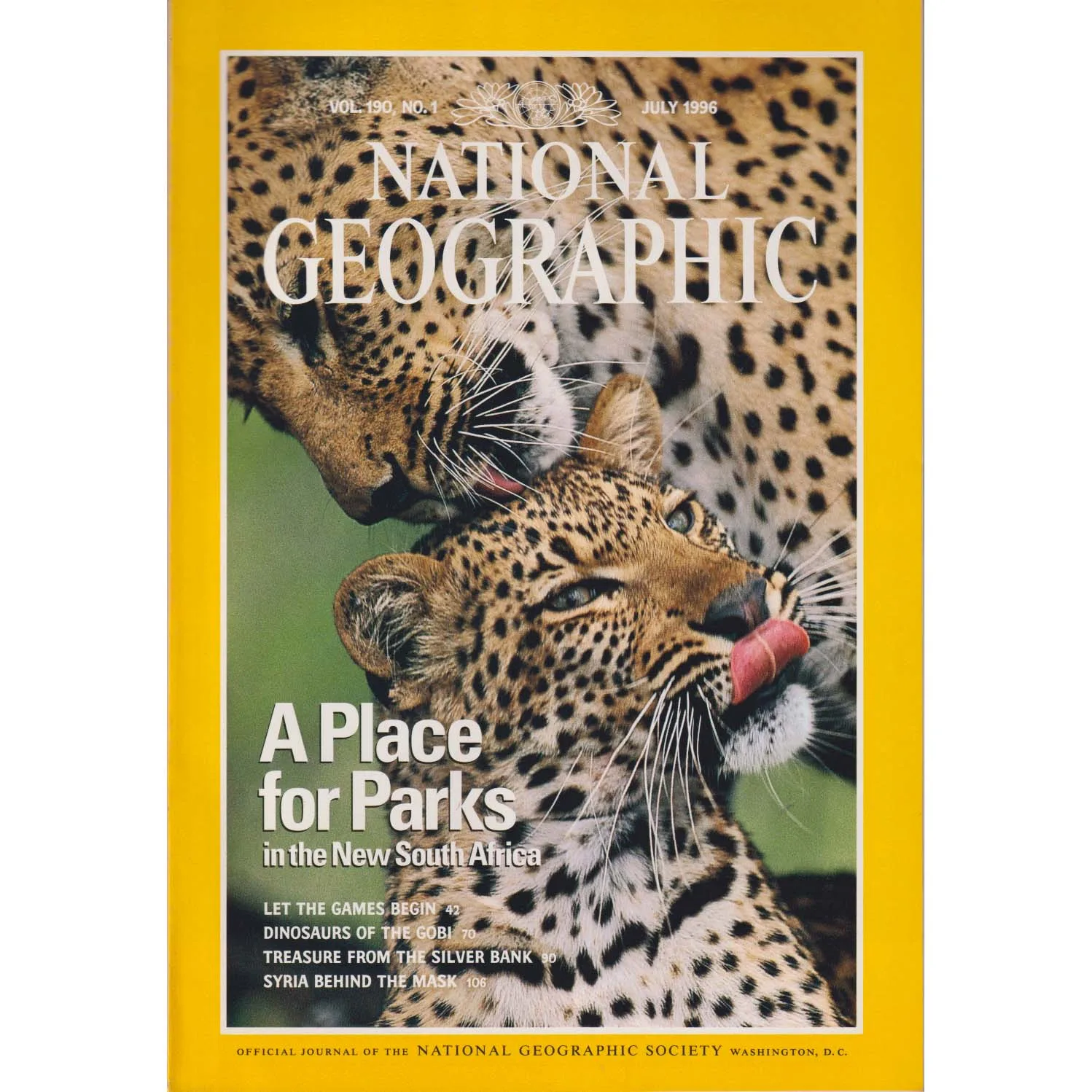
National Geographic, July 1996 arrives in its classic yellow frame with the sort of cover that makes you stop mid-scroll and remember print magazines used to win. Two leopards fill the page—one giving the other an unmistakably affectionate (and slightly possessive) lick—while the headline calmly frames it as public policy: “A Place for Parks in the New South Africa.” Which is perfect Nat Geo logic: start with big cats doing big cat things, then pivot straight into the complicated business of land, history, identity, and who gets to belong where.
This is the mid-90s at full volume: post–Cold War optimism, the glow of “new” nations rewriting themselves, and National Geographic trying to document the moment without turning it into a postcard. The feature on parks and the New South Africa isn’t just about wildlife and scenery—it’s about what conservation means when the country itself is changing shape, when protected spaces sit alongside questions of access, justice, tourism, livelihoods, and memory. It’s nature as politics, and politics as geography, wrapped up in glossy photography that makes you feel like you’ve been granted a visitor pass to the real world.
The cover image is also an accidental metaphor for the entire issue: tenderness and tension at the same time. Leopards can look like love; they can also look like dominance. Conservation can be protection; it can also be exclusion. Nat Geo, in its politely authoritative voice, wanders right into that complexity and expects you to keep up—because this is 1996 and attention spans were still allowed to have muscles.
And then, because National Geographic is incapable of staying in one lane, the rest of the contents is an absolute buffet of delightful whiplash: “Let the Games Begin” (sport, spectacle, human theatre), Dinosaurs of the Gobi (because every issue needs at least one deep-time detour), Treasure from the Silver Bank (underwater riches, the ocean being dramatic again), and Syria Behind the Mask (a phrase that now reads like a time capsule with sharp edges). It’s the kind of editorial spread that says, “Here’s a leopard lick, apartheid’s aftermath, fossils, sea mysteries, and the Levant—enjoy your evening.”
Condition: Good, which is ideal: this is a magazine meant to be handled, thumbed, and left open on a table to make visitors pretend they’re the sort of person who casually reads about South African land policy and Mongolian palaeontology. Sold by Crappy Old Books, which feels almost too perfect—because inside this scruffy little second-hand listing is a glossy, serious, surprisingly tender snapshot of a world mid-transition, plus leopards reminding you that even the most beautiful things come with claws.
Keep browsing: See more National Geographic books Other books by National Geographic
