


Frontiers Of Astronomy
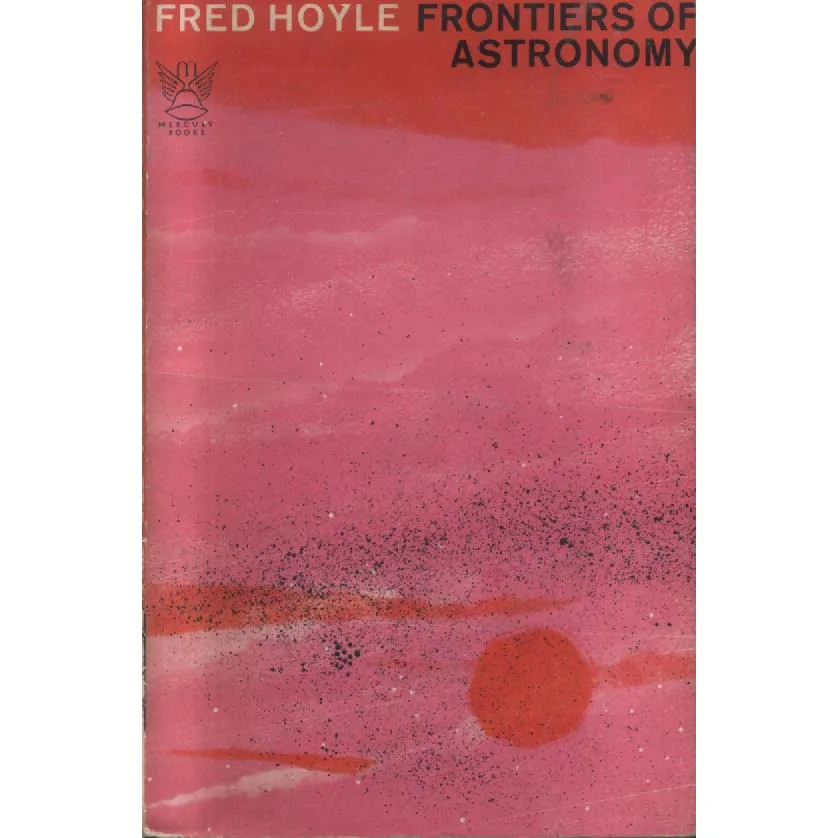
Publisher: Mercury Books
Format: Paperback
ISBN: none
Frontiers of Astronomy (1961)
Fred Hoyle – Mercury Books
ISBN: none (issued when galaxies, not barcodes, were the big mystery)
Condition: Good
Vendor: Crappy Old Books
Before the age of glossy space documentaries and CGI black holes, there was Fred Hoyle: professional contrarian, serious cosmologist, and the man who helped explain how stars make elements while muttering darkly about the Big Bang.
Frontiers of Astronomy is Hoyle in full flight: a grand tour of the universe as understood around 1961, when quasars were suspicious, galaxies were still arguing about their distances, and cosmology was basically a high-level academic bar fight with differential equations.
Inside these satisfyingly vintage pages you’ll find:
-
Stars being taken very seriously indeed: how they form, burn, wobble, explode and generally turn hydrogen into everything in your body and most of your bookshelf.
-
Galaxies as enormous, argumentative families of stars, spinning around like they’re late for something, with Hoyle calmly explaining how we figured out they exist at all.
-
A tour through nebulae, interstellar gas, radiation and cosmic rays, back when we were still working out if the universe was trying to kill us politely or enthusiastically.
-
Cosmological models explained in proper grown-up prose, including Hoyle’s beloved Steady State universe—a cosmos with no beginning, no end, and a strong dislike of the phrase “Big Bang” (which, of course, he invented as an insult).
-
That delightful mid-century confidence that if you throw enough maths and telescopes at the sky, it will eventually give up all its secrets and stop being awkward.
This isn’t pop-science fluff. This is the real deal: lucid, rigorous explanation aimed at the serious lay reader who doesn’t faint at the phrase “nuclear processes in stellar interiors.”
Our copy is graded Good, which in the unvarnished idiom of Crappy Old Books means:
-
The cover is solid and presentable, with some light rubbing, minor edge wear, or the odd small crease—exactly what you’d expect from a paperback that has orbited a few bookshelves over the last sixty-odd years.
-
The spine is sound, likely creased in a dignified way that says “someone actually read me” rather than “I’ve been posing untouched since the Kennedy administration.”
-
The pages are all present, firmly bound and entirely legible, with that lovely warm, ivory tone that only time and decent paper can produce. A tiny smudge or faint pencil tick here or there may betray a previous owner who actually did the exercises at the end of the chapter (or at least pretended to).
-
No catastrophic foxing storms, no loose signatures, no tea-tsunami across the Crab Nebula chapter. Just honest, age-appropriate wear for a working, thinking copy.
Not mint, not “mint-condition-space-museum,” but exactly right for actually learning things about stars without worrying about fingerprints.
Perfect for:
-
Astronomy nerds who want to see how the cosmos looked to one of the 20th century’s sharpest astrophysicists before later discoveries rewrote the script.
-
History-of-science buffs who enjoy reading old theories with affectionate hindsight (“ah yes, when we thought that still worked…”).
-
Readers who like their science writing dense, clear and slightly opinionated, rather than sprinkled with “10 Amazing Space Facts!!”.
-
Anyone who finds it comforting that the universe used to be even more confusing, and very clever people argued about it in print.
Frontiers of Astronomy is a time capsule from the age when cosmology was still figuring out whether the universe had a beginning, an end, or just a lot of personality—and Fred Hoyle was right in the middle of the argument.
Available now from Crappy Old Books, where our horizons are expanding, our paperbacks are honestly worn, and our “Good” condition means the only thing that’s truly ancient here is the starlight Hoyle’s talking about.
Keep browsing: See more Space books Other books by Fred Hoyle
