


Baedekers Tyrol And The Dolomites - Including The Bavarian Alps
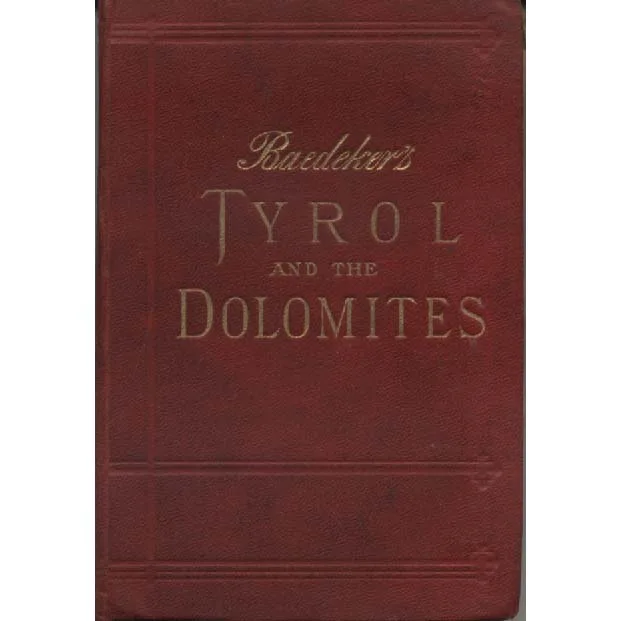
Publisher: Karl Baedeker
Format: Paperback
ISBN: none
Baedeker’s Tyrol and the Dolomites – Including the Bavarian Alps (1927)
By Karl Baedeker | Karl Baedeker
ISBN: none (older than your grandparents’ passports)
Condition: Good (well-travelled, still map-worthy)
Offered by: Crappy Old Books
Before there were influencers, there were Baedekers—small red bricks of authority that told polite people exactly where to go, what to see, and how many francs they should tip for it.
This is Baedeker’s Tyrol and the Dolomites – Including the Bavarian Alps (1927), a guide to the mountains from an era when:
-
“Hiking” meant tweed, stout boots and an iron will
-
Luggage had straps and stories
-
And nobody would dream of going anywhere without a good stiff list of recommended hotels and altitudes.
What’s inside (apart from tiny print and stern efficiency)
Open it up and you’ll find:
-
Meticulous descriptions of towns, villages, passes and peaks across Tyrol, the Dolomites and the Bavarian Alps.
-
Lists of hotels and pensions (“first-class”, “second-class”, and the implied third class: “don’t”).
-
Route suggestions for:
-
Gentle valley strolls
-
Respectable Alpine walks
-
And “you should really have a guide, a rope, and your affairs in order” ascents
-
-
Train connections, carriage routes, distances and times—this was Google Maps before Google, maps, or sensible shoes.
It’s written in that classic Baedeker voice: calm, authoritative, and faintly convinced you might get yourself into trouble without it.
The charm of a 1927 guidebook
There’s something deeply satisfying about:
-
Reading which hotels were considered “modern” in 1927
-
Discovering which beauty spots were already famous and which were still “quietly visited by the discerning few”
-
Seeing an entire region organised into neat paragraphs of views, churches, waterfalls and “good cuisine”
There are no glossy photos, no “Top Ten Must-See” boxes, no pastel infographics—just concentrated, no-nonsense information and the odd politely cutting remark.
This particular copy
-
Condition: Good – which, for a 1927 Baedeker, is downright heroic:
-
The red cloth boards still respectable, though likely showing the usual rubbing and small knocks from a life in rucksacks and bookshelves.
-
The binding is holding together: no pages trying to escape down the Brenner Pass.
-
The maps—those glorious, fold-out, Baedeker maps—are present and usable, perhaps with a crease or two that says “someone actually unfolded me on a windy ridge once.”
-
There may be:
-
Slight page toning (as expected from something that’s seen more than one currency collapse).
-
Possibly a pencilled tick or underlining where a long-ago traveller actually followed the advice.
But no catastrophic tears, no atlas-level amputations, no evidence it served as an emergency umbrella.
The vibe
Reading Baedeker’s Tyrol and the Dolomites feels like:
-
Travelling with a very organised, slightly fussy uncle who knows:
-
Which inn is decent
-
Which view is “celebrated”
-
And which church is “of no particular interest” (Baedeker could be brutal).
-
-
Looking at modern tourism and realising:
-
The mountains are the same
-
The people taking photos are the same
-
The packaging has just become less honest and much more neon
-
-
Being quietly tempted to plan a trip based entirely on century-old recommendations, just to see what’s still there.
It’s time travel in handbook form: one minute you’re on your sofa, the next you’re boarding a narrow-gauge railway in 1927, wondering whether your hat is adequate.
Why you might actually want this
-
You love the Alps, Tyrol, or the Dolomites, and you’re curious how they looked to travellers nearly 100 years ago.
-
You collect Baedekers or classic guidebooks and want a solid, real-world example that was made to be used, not entombed.
-
You’re into historical travel writing, timetables, and the old art of going somewhere slowly.
-
You’re planning a modern trip and like the idea of cross-referencing your smartphone with a 1927 book that refers to “motor-cars” as something new and slightly suspect.
It’s also a superb prop: put it on a table and the room instantly becomes 40% more “well-travelled”.
Condition vs. Adventure
-
Physically: Good – strong enough to be handled, opened, consulted and admired without fear.
-
Spiritually: brimming with the ghost of steam trains, cable cars, and holiday-makers who thought a glacier walk was a nice afternoon outing.
You can:
-
Read it for the history
-
Use it as inspiration
-
Or just flip through the maps and imagine following those red lines on foot, without a single notification pinging.
Ideal for:
-
Alpine romantics and Dolomite devotees
-
Map nerds, historians, and vintage travel geeks
-
People who appreciate the dry wit of old guidebook prose
-
Anyone who finds it deliciously ironic that a once-premier European guidebook is now sold—still in Good condition—by an outfit called Crappy Old Books
Offered by Crappy Old Books, where the mountains are eternal, the Baedekers are red, the condition is Good, and your next imaginary 1927 Alpine holiday is only a few pages away.
Keep browsing: See more Travel books Other books by Karl Baedeker
