


Aiming For The Stars - The Dreamers And Doers Of The Space Age
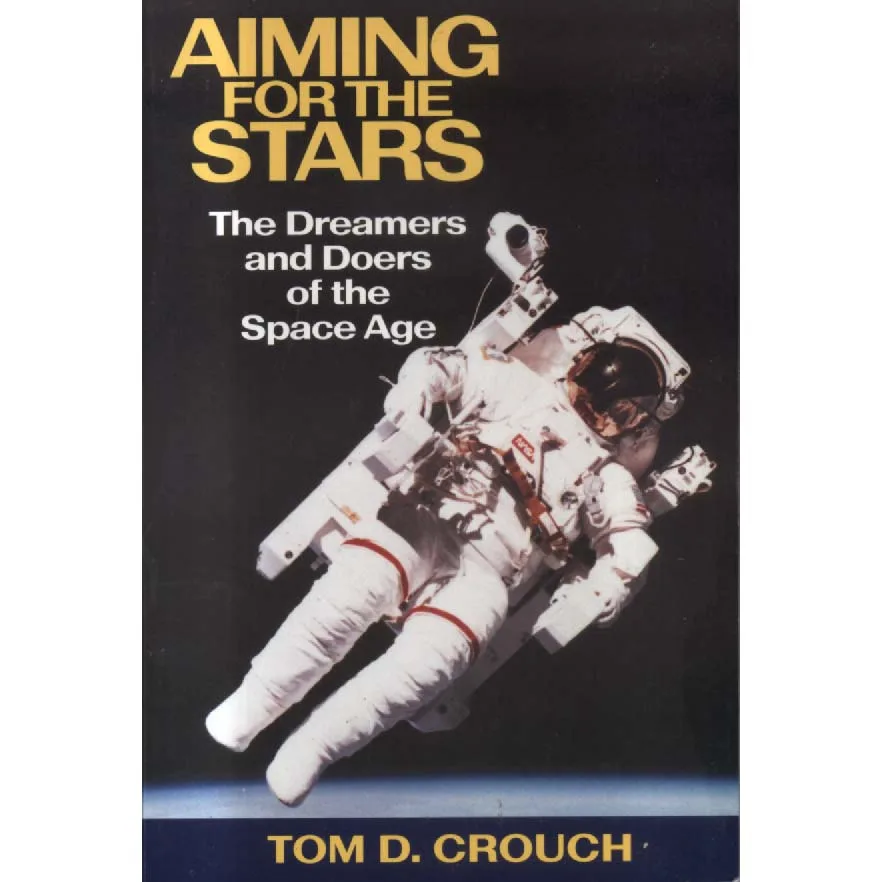
Publisher: Smithsonian
Format: Paperback
ISBN: 9781560988335
Aiming for the Stars – The Dreamers and Doers of the Space Age (1999)
By Tom D. Crouch | Smithsonian Institution Press
ISBN: 9781560988335
Condition: Good (orbit-stable, lightly annotated)
Offered by: Crappy Old Books
If you’ve ever stared at the night sky and thought, “Who looked at this and decided ‘yes, let’s sit on an explosive tube and go up there’?”—this is your book.
Aiming for the Stars is Tom D. Crouch’s guided tour through the human side of the Space Age: the dreamers, the engineers, the test pilots, the bureaucrats (yes, even them), and the occasional slightly unhinged visionary who thought rocketry was a terrific hobby.
What’s inside (besides rockets and ambition)
Crouch, being a Smithsonian historian, knows his stuff and actually explains it in English. Inside you’ll find:
-
The story of how we went from paper sketches and mad-scientist goggles to Moon landings and space stations in a historical blink.
-
Portraits of the “doers”: the scientists, engineers, astronauts and policy-wranglers who pushed the whole thing forward, usually while sleep-deprived and fuelled by coffee.
-
The “dreamers”: writers, idealists, and big-picture people whose ideas were either visionary, insane, or both, depending on the decade.
-
A mix of tech, politics and personality that makes it clear space exploration was never just about rockets—it was about egos, empires, budgets and people who thought gravity was more of a suggestion.
It’s not a dry technical manual; it’s the story of how an entire civilisation got mildly obsessed with leaving the planet.
This particular copy
-
Condition: Good – solid, tidy, and entirely fit for service:
-
Binding: sound
-
Pages: all present and behaving
-
Cover: decent, possibly with a bit of light edgewear that says, “I’ve been to someone’s bedside table and back.”
-
-
It does have a small splattering of helpful underlining:
-
Someone before you clearly took this seriously enough to mark a few key passages.
-
No wild graffiti, no neon highlighter massacre—just focused, “this bit is important / interesting” underlines.
-
If anything, it’s like buying a book that arrives with pre-installed enthusiasm.
The vibe
Reading this feels like:
-
Sitting next to a very knowledgeable person at a dinner party who actually knows when to stop talking about thrust-to-weight ratios.
-
Getting the backstage pass version of space history: the hopes, the rivalries, the absurdities, and the occasional “we really did what with slide rules?” moment.
-
Realising that the Space Age was driven not just by genius, but by people who were profoundly allergic to the word “impossible”.
It’s thoughtful and well-researched, but not pompous. You get big ideas explained with clarity, not with charts that need a PhD to parse.
About that underlining
Let’s talk about the “small splattering of helpful underlining”:
-
It doesn’t obscure the text; it guides your eye to bits a previous reader thought mattered—like cosmic breadcrumbs.
-
It suggests this book was once used by a real, engaged human: a student, a space nerd, or someone preparing to win arguments about Apollo at parties.
-
For some people this is a flaw; for others it’s built-in commentary. If you’re the latter, congratulations, you’ve just acquired a lightly co-piloted reading experience.
No words are missing, no pages are loose—just the occasional line quietly saying, “Hey, pay attention here.”
Why you might want this on your shelf
-
You like space history, but want more than a timeline of launches—you want the people who made it all happen.
-
You’re fond of Smithsonian-level detail without needing a second brain to process it.
-
You enjoy books that cover both the romance and the bureaucracy of the Space Age—because nothing gets into orbit without both dreamers and forms in triplicate.
-
You’re building a small but formidable corner of your library dedicated to “humans vs. gravity”.
Ideal for:
-
Space nerds, casual stargazers and anyone who’s memorised at least one rocket name for fun.
-
Readers who like their non-fiction well-written, human-focused, and not allergic to complexity.
-
People who don’t mind a bit of tasteful underlining in exchange for a properly Good copy at a sensible price.
-
Anyone who thinks it’s perfectly appropriate that a book about aiming for the stars is being sold by a place called Crappy Old Books.
Launched into the second-hand cosmos by Crappy Old Books, where the condition is Good, the margins are lightly enlisted, and the dreamers and doers of the Space Age are still very much ready for lift-off.
Keep browsing: See more Space books Other books by Tom D Crouch
