


Foundations Of Wireless
Publisher: Iliffe
Format: Hardback
ISBN: none
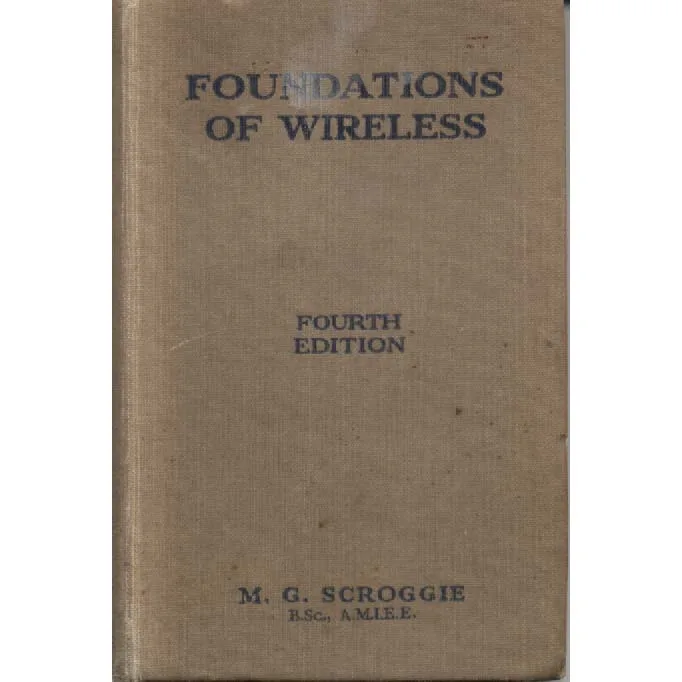
Foundations of Wireless (1945) – M. G. Scroggie
Iliffe & Sons • ISBN: nobly pre-ISBN
Condition: Good
Still faintly humming with potential, via: Crappy Old Books
Before Bluetooth, before Wi-Fi, before the phrase “Have you tried turning it off and on again?”, there was wireless—a mysterious art involving coils, condensers, glowing valves and the occasional smell of hot dust. And presiding over it, with brisk authority, was M. G. Scroggie, who wrote Foundations of Wireless in 1945 to explain to mere mortals how radio actually works, instead of just calling it “magic in a box” and going to make tea.
This is not a glossy, modern “Teach Yourself Electronics in 24 Hours” affair. This is proper wartime/just-post-wartime engineering prose, in which:
-
Electrons march dutifully through circuits with military discipline.
-
Equations appear without apology, assuming the reader owns both a brain and a pencil.
-
Valves (tubes, for transatlantic heretics) are treated as noble, fragile beings deserving of care, reverence, and the occasional replacement.
-
The word “wireless” is used completely unironically, because nothing else needed naming after it yet.
Scroggie patiently explains the basics: oscillators, rectifiers, amplification, modulation, demodulation, and all the other clever tricks that allow voices and music to be hurled invisibly through the air and recomposed into recognisable noise at the other end. It’s the kind of book that assumes you might actually build something afterwards—possibly on the kitchen table, to the alarm of everyone else in the house.
Reading it now is a delightful experience: half solid technical grounding, half time travel to a world in which components had leads, radios glowed, and “portable” meant “liftable by two determined adults.”
Now, about this particular copy, as rated with icy honesty by Crappy Old Books:
-
Condition: Good – which means this is a sound, wholly serviceable volume. The spine is firm, the pages are all attached, and the book does not attempt to convert itself into a loose-leaf binder the moment you open it.
-
The boards show honest wear: a bit of rubbing to the edges, perhaps a bumped corner, the sort of patina acquired from decades on workbenches, desks, and next to smokey soldering irons. No horror, just history.
-
The pages have mellowed into that comfortable off-white/very-light-tea colour, but the print remains crisp enough that even the tiny circuit diagrams haven’t faded into hieroglyphs.
You may also find:
-
A previous owner’s name inside the front cover, possibly followed by a callsign, which is how you know they were serious.
-
Pencil notes in the margins, such as “CHECK THIS” or “works!” or the classic “???” next to some particularly elegant but baffling algebra.
-
A faint, nostalgic aroma of old paper, warm components, and long-dead bakelite.
Things you will not find:
-
An ISBN. This is 1945. Books were catalogued using titles, authors, and the librarian’s memory, not international product codes.
-
Any mention of integrated circuits, microcontrollers, or software-defined anything. The most advanced “chip” here is a very determined valve.
-
QR codes, web links, or online resources. If you want answers, you consult the index, not a search engine.
This Good copy of Foundations of Wireless is perfect if you:
-
Secretly believe that real electronics contains at least one coil you wound yourself.
-
Want to understand radio from the ground up, rather than from the “here’s a module, don’t touch it” school of modern hobbyism.
-
Collect classic technical texts, especially the kind printed when diagrams were drawn with ink, rulers and a sense of duty.
-
Enjoy the slightly smug pleasure of reading sections aloud and thinking, “My phone does all of this, badly, in software.”
So here it is: M. G. Scroggie’s calm, rigorous guide to how wireless actually works, still standing after nearly eighty years, its circuits intact even if some of its readers are now purely theoretical.
A sturdy, gently worn, thoroughly respectable Good copy—ready to explain RF fundamentals to anyone patient enough to listen—brought to you with a crackle, a hiss, and a grin by Crappy Old Books.
Keep browsing: See more Academic books Other books by MG scroggie
