


Tacitus - Histories I
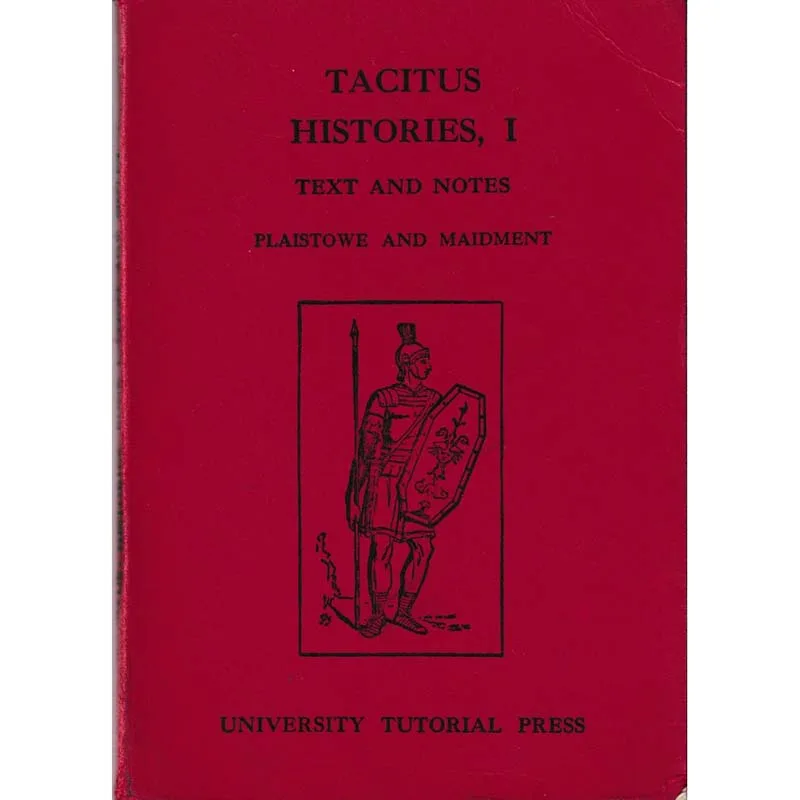
Publisher: University Tutorial Press
Format: Paperback
ISBN: none
Tacitus — Histories I
Editors: Plaistowe & Maidment • Publisher: University Tutorial Press
ISBN: none (Rome preferred inscriptions)
Condition: Good (sardonic, serviceable, suspicious of emperors)
Imprint: Crappy Old Books
Provenance: Ex–Old Palace School, Croydon (where Latin met drizzle and cultivated a dry wit)
Date note: probably earlier than 1969; “1969” helpfully written on the front endpaper by someone with a pen and a sense of occasion.
Enclosure: a small card of Luca della Robbia (1963) with the handwritten legend “Going Out”—surely the most Tacitean memo ever slipped between pages.
Welcome to Book I of the Histories, where AD 69—the Year of the Four Emperors—arrives like a badly organised staff meeting: everyone claims the chair, nobody brings biscuits, and Rome burns through leadership the way sixth-formers burn through biros. Tacitus recounts it all with the calm malice of a man who keeps receipts. Plaistowe and Maidment, those sturdy sherpas of University Tutorial Press, supply notes that will stop your ablatives absolute from mutiny and an apparatus that behaves like a form master: brisk, exact, faintly disappointed, tremendously useful.
Condition “Good” here means the book has been to school and learned to stand up straight. The boards are square, the hinges sound, the text-block a respectable ivory with a civil dusting of foxing (more tea-room vapour than Vesuvius). Expect the scholastic trifecta: an Old Palace stamp (ceremonial), a pencilled shelfmark in the tidy hand of bureaucracy, and the faint ghost of a date-due slip loitering where empire used to be. Corners are agreeably rounded by decades of satchels; pages turn with the soft confidence of a prefect’s cough.
Inside, Tacitus does what Tacitus does: compresses catastrophe into crystalline Latin and then looks at you as if to say, “Are we quite done with illusions?” You get Galba being economical, Otho being optimistic, Vitellius being hungry, and Vespasian being inevitable. The prose is lean, the irony bone-dry, the judgments laconic enough to cut glass. When the senate debates, it sounds like weather; when the legions march, they sound like policy. Between lines you hear the author filing a cold, beautiful indictment of how power behaves when it thinks nobody is marking.
The editors’ apparatus is mercifully practical—maps that keep your legions out of the wrong province, vocabulary that arrives exactly when your courage fails, and syntax triage for the more barbed periods. If a previous scholar has sprinkled marginalia, it tends to be of the improving sort: “sine ira et studio (lol)” in pencil; an emphatic “historic infinitive!” flung like a standard; perhaps a neat underline beneath an especially chilling sententia.
About that Luca della Robbia card, dated 1963 and inscribed “Going Out.” We believe it’s a message from the previous owner to future readers: in Tacitus, people are always going out—of favour, of office, of life. Alternatively, it marked a school outing; the effect is the same. Consider it your portable caption for AD 69.
As a reading copy: superb; the Latin prints clean, the notes are grown-up, and you will find yourself murmuring “indeed” in a tone that alarms friends.
As a relic: even better; it radiates the calm authority of a classroom where one is expected to parse a coup before lunch.
Deploy these at tea (or tribunal):
-
“Tacitus writes like a prosecutor who never raises his voice.”
-
“Galba brought disciplina, Otho brought mirrors, Vitellius brought lunch, Vespasian brought the invoice.”
-
“Sine ira et studio is the original content policy.”
-
Point to the tide-mark of time and murmur, “Institutional memory.”
Physical particulars, frankly declared: boards scuffed but dignified; spine lettering present and sober; pages clean with light age-toning; no structural compromise; the mysterious 1969 inscription present and correct; Luca card tucked in like a relic of the cult of Good Taste.
Ideal for: readers who like their history with edge and evidence, teachers who appreciate a note that says exactly enough, and collectors who enjoy the scent of library, polish, and quiet revolt.
Crappy Old Books guarantee: we do not sell mint; we sell books with alibis. If you want a sterile reprint, plenty exist. If you want Tacitus in a Croydon school blazer, side-eyeing empire while keeping your syntax marching in step, this is your copy.
Keep browsing: See more Ancient Classics books Other books by Plaistowe and Maidment
