


The Shorter Latin Primer
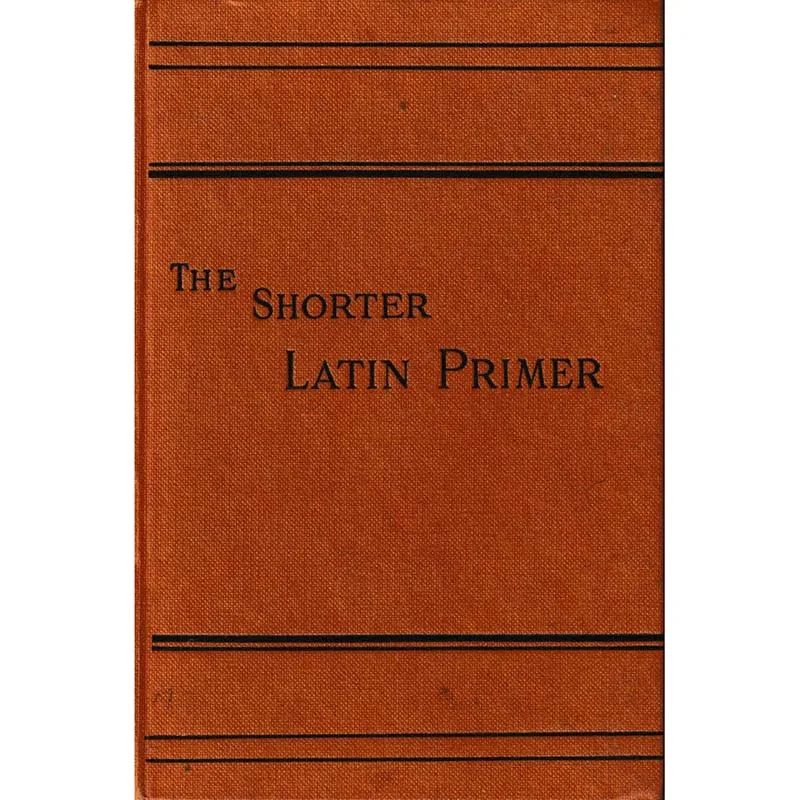
Publisher: Lomgmans Green and Co
Format: Hardback
ISBN: none
The Shorter Latin Primer (1958)
Author/Editor: J. W. Bartram • Publisher: Longmans, Green and Co
ISBN: none (amo, amas, ISBN non est)
Condition: Good (upright, chalk-dusted, indomitable)
Imprint: Crappy Old Books
Behold the pocket anvil on which generations had their grammar hammered: The Shorter Latin Primer, the brisk little volume that can turn “I saw a girl” into a moral drama about the ablative absolute before elevenses. Bartram’s 1958 iteration is the one with all the greatest hits—first declension to your left, fourth declension to your right, and somewhere in the middle a stern reminder that agricola is masculine however pink the endings may look.
Condition “Good” here means battle-tested, not battle-weary. The boards are square, the hinges firm, the text-block a gentlemanly ivory with a polite dusting of foxing (more digestive biscuit than Pompeian ash). Corners show the honest rounding of satchel years. You may encounter the classic artefacts of study: a pencilled amo/amas/amat warm-up in the endpapers, a faint timetable for verbs that will never leave you (“sum, es, est—don’t panic”), and perhaps the spectral outline of a timetable that once promised double Latin and delivered destiny.
Inside, the pages parade in immaculate ranks: nouns declinable at speed, adjectives agreeing like well-brought-up cousins, pronouns lurking with intent, and verbs—sweet immortal verbs—conjugated until the subjunctive purrs. The gerundive of obligation is introduced with the nonchalance of a headmaster (“it must be done”), and the indirect statement arrives on time, ushering in accusative + infinitive with a flourish and no apology. Irregulars are corralled into honest tables; particles behave; and somewhere, between hic, haec, hoc and ille, illa, illud, you realise English has been slacking off for years.
Bartram’s tone is the kind that stands with hands behind back and expects the ablative to pull itself together. Examples are crisp, irreproachable, and alarmingly re-usable: puella rosas portat has never carried so much freight. There is a tidy little map of syntax where nothing grows wild; even sequence of tenses—that hedge-maze of hope and regret—has paths trimmed and labelled.
As a working copy, this is perfect; as a relic, it radiates the cool authority of a well-burnished ruler. Keep it on the desk and your emails will mysteriously pick up parallelism. Take it on the train and strangers may remember their schooldays and confess to a fondness for ablatives of means. Use it, and English will feel suddenly under-declined.
Party tricks included at no extra charge:
-
Decline bellum without blinking while someone fetches wine.
-
Explain the accusative of duration in one sentence and win a bet.
-
Intone “ut + subjunctive” like a spell and make a sentence behave.
-
Reveal that Carthago delenda est is less a threat than a tidy piece of grammar.
Physical charms, frankly disclosed: a few neat underlinings (ambition), light margin ticks (approval), no loose gatherings (discipline), faint scent of library and chalk (character). The kind of “Good” that outlives fads and remembers where you put the vocative.
Crappy Old Books guarantee: we don’t sell mint; we sell usefully indestructible. If you want a prim, untouched primer, buy a reprint. If you want the little redoubt that actually teaches you Latin—and looks ready to do another fifty years of it—this is your copy.
Keep browsing: See more Ancient Classics books Other books by JW Bartram
