


Caesar Book II
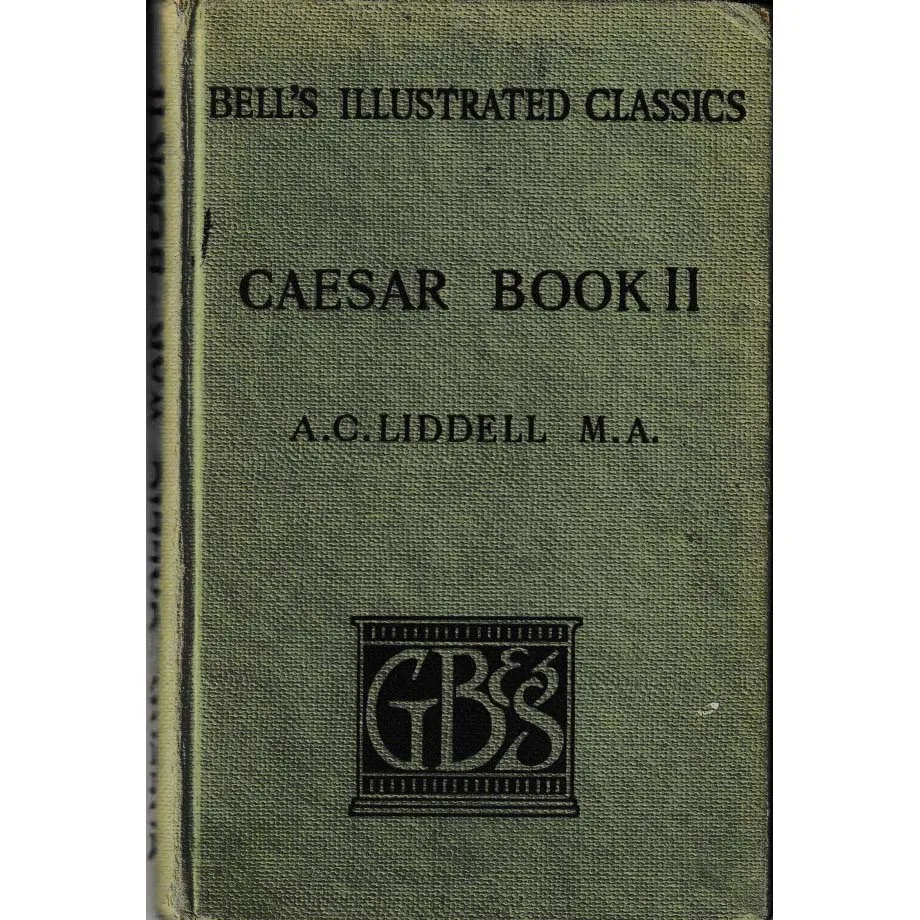
Publisher: Bells Illustrated Classics
Format: Hardback
ISBN: none
Caesar — Book II (1899)
Editor: A. C. Liddell • Series: Bell’s Illustrated Classics
Publisher: G. Bell & Sons
ISBN: none (Caesar counted in cohorts, not ISBNs)
Condition: Good (disciplined, parade-ready)
Imprint: Crappy Old Books
Provenance: Ex–Old Palace School, Croydon (where Latin verbs were conjugated with military efficiency)
All hail a field report disguised as a school book: Book II of Caesar, freshly marched out of 1899 in the stout Bell’s livery, illustrated for those who like their ablatives supported by pictures of forts. Here is the Commentarii at its most admirably unfussy—enemy sighted, bridge built, speech delivered, victory achieved before lunch. To read it is to watch a commander dictate sentence clauses the way he lays out a camp: straight, braced, and with ditches.
Condition “Good” means the volume has survived a century of young strategists with nothing worse than campaign scuffs. Boards show honest shelfwear; spine lettering remains legible (like a standard raised above the din). Hinges are sound; gatherings hold formation. Expect the venerable trifecta of scholastic bureaucracy: Old Palace stamps, a pencil shelf-mark in a hand that brooks no nonsense, and the fossil imprint of a date-due slip. Paper is a gentlemanly ivory with the light foxing of a Belgian morning mist. Marginalia—if any—tend to be tactical: “ut = so that (purpose),” “GERUN-DIVE!!,” and the occasional small map where a previous owner rehearsed an encirclement of the optative.
Because this is Bell’s Illustrated Classics, you also get the period’s best visual aids: neat woodcuts of pilum and vallum, impassive Gauls resisting the urge to be impressed, and diagrams of siege works that look like they were drafted by a head prefect with a set square. A. C. Liddell supplies sturdy notes—the kind that march briskly from grammar to ground truth. He assumes you can think, and if you cannot, he has drawn you a fort.
Inside the text, the Caesarian voice remains the greatest deadpan in literature. “He, having seen this, did that;” empires have been founded with less charisma. You will witness the tidy ruthlessness of the Belgae being reasoned with, the sly charm of “nostri” used to mean both “our men” and “the reader’s favourite team,” and the everlasting joy of subordinate clauses falling into line like centurions at inspection.
As a reading copy, it excels; as a relic, it’s a museum of scholastic logistics. Hold it and you can almost hear the scrape of desks, the murmur of oratio obliqua, and a teacher saying, “Translate quietly; imagine yourself in command.” Place it on your shelf and your other classics will start measuring out rations.
For the bluffer’s banquet:
-
Know that Book II contains the orderly thrashings that taught Britain the value of a good abatis.
-
Quote “Gallia est omnis divisa …” as if you personally surveyed it.
-
Point at the illustrations and say, “Note the agger; Bell understood pedagogy.”
Crappy Old Books guarantee: we don’t sell mint—we sell battle-tested. If you want Caesar sanitized, try a modern paperback. If you want Caesar who has already survived the Croydon campaign and still keeps his lines straight, this is your veteran. Dismiss.
Keep browsing: See more Ancient Classics books Other books by AC Liddell
