


Voyage - The Coast Of Utopia Part I
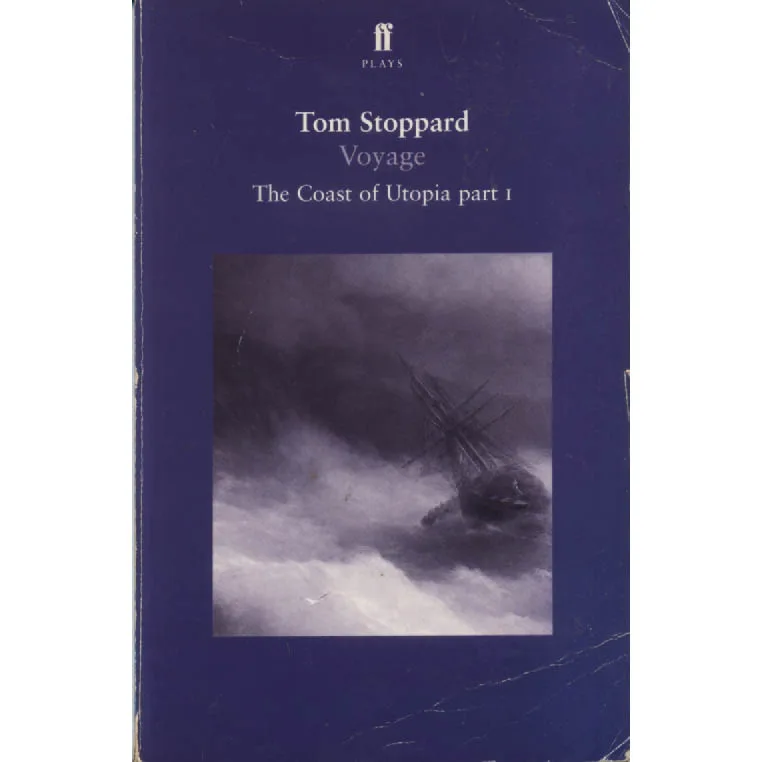
Publisher: Faber and Faber
Format: Paperback
ISBN: 9780571216611
Presenting: Voyage — The Coast of Utopia, Part I (2002, Faber & Faber) by Tom Stoppard — the prelude where ideas pack their trunks, kiss the old century goodbye, and try to catch the right train. ISBN: 9780571216611. Condition: Good, which in the venerable dialect of second-hand booksellers means “well-behaved, fully readable, and ready to start an argument in a café without shedding pages.”
This is the opening gambit of Stoppard’s grand, giddy waltz through 19th-century Russian thought, when the future still wore kid gloves and everyone had a manifesto in their coat pocket. Country estates hum with philosophy; salons vibrate like tuning forks; friendships are formed at the speed of an epigram and broken by the velocity of history. Herzen dreams aloud, Bakunin detonates sentences on contact, Turgenev arrives with impeccable manners and inconvenient feelings, and Belinsky edits reality with a blue pencil and a pulse. Before barricades and bulletins, there are picnics, quarrels, and the seductive notion that the right conversation might save the world.
From the outside: the tidy Faber & Faber paperback — elegant cover, sensible heft, and that poised “we’ve seen a couple of revolutions” posture on the shelf. Expect honest edge rub, a courteous spine crease (more “raised eyebrow” than “battle scar”), and pages in a tasteful early-2000s cream. Nothing alarming: no fluorescent coups in the margins, no underlined vendettas. Our Good means the binding holds firm, the text is crisp, and the whole book sits next to your kettle like it’s thinking in paragraphs.
Inside: Stoppard’s specialty — conversation as contact sport. House parties double as think tanks; lectures slip their leashes and chase each other through forests; young radicals weigh love, duty, and train timetables with equal intensity. Mothers fret, printers smirk, money sulks, and someone always opens a window at exactly the wrong moment. It’s the intoxicating phase of history where everything is possible and nothing has yet sent a bill.
The dialogue? Effervescent with undertow. Stoppard can fit a century into a line and still leave space for a punchline. One page, they’re debating liberty and land tenure; the next, someone burns the toast and accidentally changes their life. Voyage is the chapter of arrivals: to ideas, to cities, to selves — all bright, provisional, and perilously romantic.
Why this copy? Because Crappy Old Books specialises in paradox: decidedly un-crappy plays with just enough lived-in charm to prove they were read by humans, not climate-controlled by thermostats. Our Good is the sweet spot — opens flat for impromptu table-reads, keeps its composure during rehearsal squabbles, and looks handsome queued beside your other Fabers (which, let’s be honest, are multiplying).
Ideal for:
-
Readers who like their history caffeinated and their philosophy interruptible.
-
Theatre lovers who enjoy scenes where the punchline doubles as a thesis.
-
Anyone who has ever fallen in love with an idea on a train and arrived somewhere else entirely.
Potential side effects: excessive quoting at dinner, a renewed interest in printing presses and train schedules, and the irresistible urge to classify your friends as radicals, liberals, or “it’s complicated.”
In short: a witty, generous, heady first act in which minds set sail and hearts mislay their maps. Voyage gives you the thrill of departure and the ache of choosing a direction — brought to you by Crappy Old Books, where the name is self-deprecation and the stock is revolution-ready (and pleasantly dog-eared).
Keep browsing: See more Poetry books Other books by Tom Stoppard
