Renault
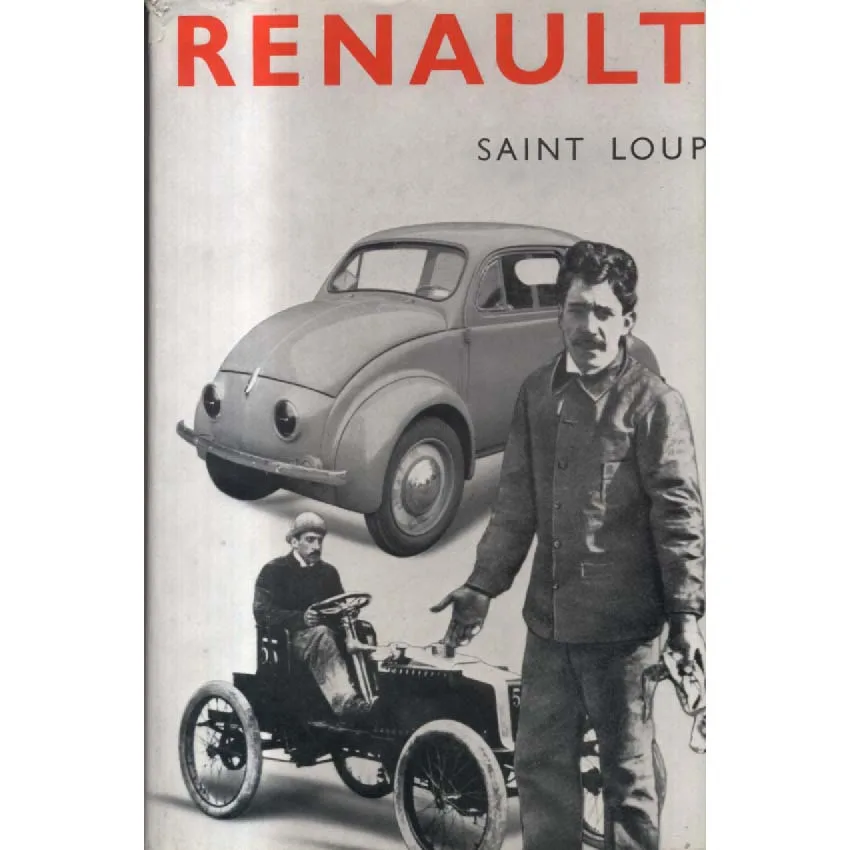
Publisher: The Bodley Head
Format: Hardback
ISBN: none
Renault (1957) — Saint Loup
The Bodley Head • ISBN: none • Condition: Good • Offered by Crappy Old Books
Behold Renault (1957), a brisk, lapel-straightening tour of France’s most industrious national pastime: turning sheet metal and stubborn optimism into cars that refuse to be dull. Saint Loup—whose name sounds like a driver you’d trust in fog—guides you from the cobbles of Billancourt to the wide, rhetorical boulevards of motoring destiny. It’s part company saga, part rolling love letter, with just enough grease under the fingernails to keep it honest.
This is the age when a bonnet was a promise and a headlamp wore its own beret. You’ll find factory floors described with the enthusiasm usually reserved for Gothic cathedrals; production lines that move with the choreography of a stern ballet; and cars that seem to shrug in French, then pull off something clever. The early legends rumble past: pragmatic workhorses that hauled a recovering nation, little city cars with big personalities, and the elegant experiment that makes you whisper “ah, that roofline.” Somewhere in these pages a test driver lights another Gauloise (entirely in your imagination), then downshifts into history.
Saint Loup writes like a confident raconteur leaning on a wing mirror: crisp, slightly mischievous, and allergic to fuss. There are photographs that look like they were developed in strong tea—factory vistas, heroic badges, coachwork profiles so precise you could shave with them. Expect engineering explained with a raised eyebrow, not a raised voice: torque figures served with a side of philosophy, gear ratios seasoned with civic pride. The subtext is pure post-war bravado: we will make something useful, then we will make it charming, and then we will drive it to lunch.
As for Condition: Good, think of it as “well-tempered.” The boards are squared away, the binding is more dependable than a Parisian waiter’s disapproval, and the pages show honest signs of readership—light rubs here, a whisper of toning there, perhaps the faint cologne of old paper and distant petrol. If a dust jacket is present, it has likely learned the delicate art of patina; if not, the book does not apologise and neither should you. No ISBN, of course—this is 1957, the romantic era when books strode into the world without numbers, just posture.
Crappy Old Books has done the only sensible thing: refrained from aromatherapy, avoided “book spa” euphemisms, and left all the lived-in dignity intact. We did not iron the pages. We did not feng-shui the endpapers. We admired the typography, nodded at the photos, and decided this volume deserved more than a warehouse shelf and less than a museum: your home.
Read it and you’ll start noticing industrial design in the wild: a bridge truss becomes a chassis, a café chair leg looks suspiciously like a control arm. You’ll speculate about gear synchros while waiting for the kettle, and you’ll catch yourself calling a practical solution elegant as though you’re appraising a roof seam. The book has that effect—quietly persuasive, mildly conspiratorial, the literary equivalent of a well-timed double-declutch.
File under mechanical romance, continental edition. Park it next to your guide to gares, your atlas with coffee stains, and your fondness for cars that are more character than commodity. And when someone asks why you’re smiling at a photograph of a modest French saloon, say the obvious: because utility, handled with style, is just another word for joy.
Keep browsing: See more Transport books Other books by Saint Loup