


Cars Of The 1930s
Publisher: BT Batsford Ltd
Format: Hardback
ISBN: 0713404655
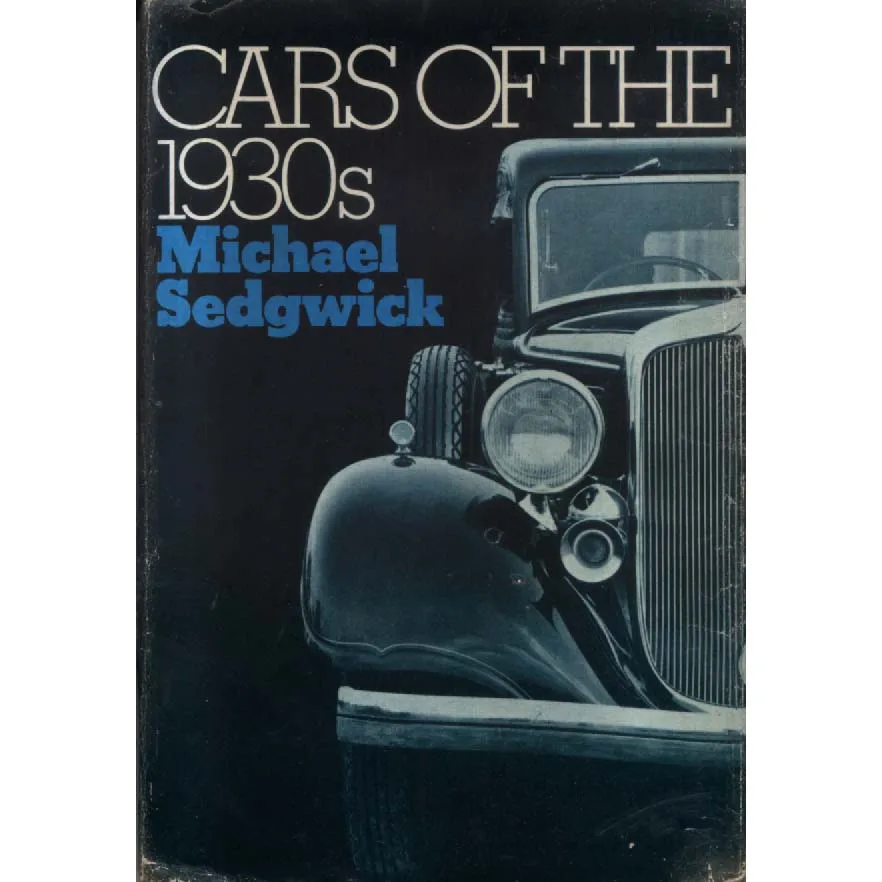
Cars of the 1930s (1970) — Michael Sedgwick
B. T. Batsford Ltd • ISBN: 0713404655 • Condition: Good (Ex-Library) • Offered by Crappy Old Books
Put on your best tweed and practise your most knowing nod: Michael Sedgwick is about to take you for a spin through the decade when cars dressed better than their owners. Cars of the 1930s is a guided promenade past Art Deco grilles, streamlining that genuinely believed in the future, and coachwork so elegant it should come with a chaperone. Sedgwick—calm, crisp, and politely authoritative—maps the era in which running boards were not ironic and door handles sometimes opened the wrong way on purpose, just to test your courage.
Expect appearances from the grandees and the heartbreakers: Bugatti Type 57 gliding like a dragonfly in a dinner jacket; Cord 810/812 showing off its hidden headlights with a conspiratorial wink; Talbot-Lago doing teardrops as if gravity is simply a rumour; Bentley being Bentley (stout of heart, quietly immodest); Packard and Auburn looking like they own the hotel, because they do; and the humble heroes—Austin Seven, Morris Eight, and Ford V-8—keeping the nation mobile while the posher set flirted with superchargers. There’s the Traction Avant turning front-wheel drive into cocktail conversation and the Mercedes 540K reminding everyone that excess can be exquisitely engineered.
Sedgwick’s captions are gently dry, the photographs handsomely sober, and the technical bits pleasingly unflustered—compression ratios and coachbuilders presented with the bedside manner of a kindly curator. It’s the 1930s without the sepia hangover: bright, mechanical, and just a touch theatrical, as if every bonnet conceals a tuxedo.
Now, about the Condition: Good (Ex-Library) part. This copy has lived an honest, municipal life. It has done time on the open shelves, learned to queue, and bears the faint tattoos of institutional affection: a cancelled stamp here, the shadow of a lending slip there, perhaps a catalogue number whispering down the spine. The boards are straight, the binding is stout, and the pages—still bright enough to outshine a foggy morning—may show the sort of well-mannered wear that comes from being consulted rather than merely owned. A hint of archival perfume (paper, paste, and a distant echo of furniture polish) may be present. In short: worked for a living; never phoned it in.
Crappy Old Books has done precisely what the situation demands: no “book spa,” no essential oils, no bullet-journal bookmarks. We’ve brushed off the dust of civic duty, saluted the date-due card like a campaign medal, and left the Mylar-crinkle memories intact. This is a survivor—a motoring title that has actually motored, checking out and returning, like a responsible Riley.
Inside, the 1930s unrolls like a well-paved B-road at dusk. You’ll see streamline fantasies that almost outran their accountants, dashboards that were unabashedly furniture, and paint colours named after aspirations (Lagoon, Ivory, Something Improbably Blue). Semaphores flick out with polite determination; spare wheels pose rakishly; mascots lead with their chins. Sedgwick keeps it all in order: the who-built-what, the why-it-mattered, the subtle distinction between “swept tail” and “please stop showing off.”
This is a book for anyone who has ever slowed down to admire a crease in a wing, believed that a proper bonnet can also be a horizon, or suspected that the world lost something when trafficators gave way to indicators that do not click. Read it at your desk and suddenly your stapler looks under-chromed. Read it on the bus and you’ll start assigning coachbuilders to fellow passengers. Read it in the garage and the spanners will sit up straighter.
Adopt this veteran of the public stacks and give it a quieter home. Park it on your shelf at a jaunty angle. When friends ask why you’re smiling at a photograph of a Delahaye, you can say—with all the weary glamour of the pre-war motorist—“Because some lines don’t need wind tunnels, they just need nerve.” And if they raise an eyebrow at the library stamps, tell them the truth: provenance is the new patina.
Keep browsing: See more Transport books Other books by Michael Sedgwick
