


Junior School Mathematics
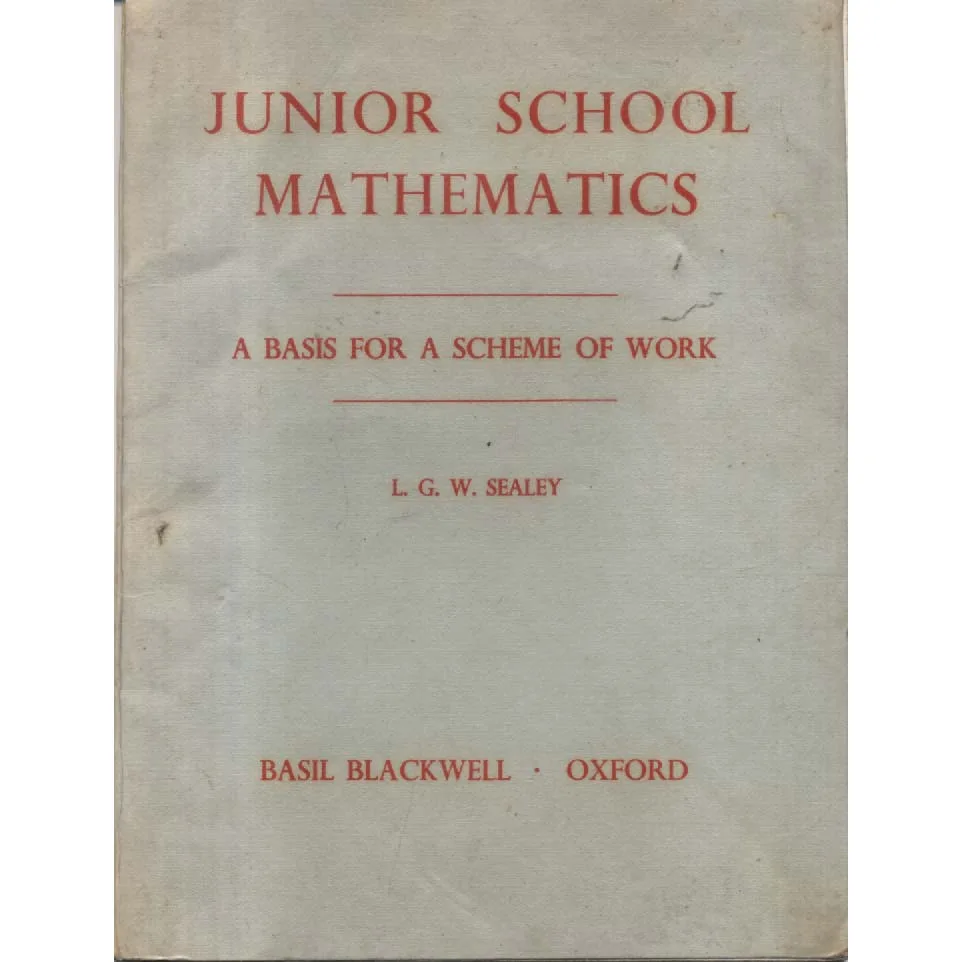
Publisher: Basil Blackwell
Format: Paperback
ISBN: none
Welcome to the whimsical world of “Junior School Mathematics,” a tome so thrilling it could make a calculator blush. Published in the avant-garde year of 1967 by the esteemed Basil Blackwell, this book is a veritable time capsule of educational rigour, where the numbers dance like they’re at a 60s disco but with a lot less rhythm. LGW Sealey, the enigmatic author, is here to take you on a mathematical journey that’s just as much about the journey as it is about the arithmetic.
This is a thin volume of 37 pages with big text, but its otherwise awesome.
Now, one might wonder what pearls of wisdom await within the pages of this second-hand classic. Does it offer sage advice on the mystique of multiplication? Or perhaps it reveals the depths of division with the flair of a magician pulling rabbits from hats? In a world that has since upgraded to calculators with more functions than a Swiss army knife, this book dares to tackle the daunting art of long division with a pencil and paper, as if to say, “Who needs technology when you have the spirit of math?”
With its charmingly outdated illustrations and diagrams that seem to have been lifted straight from the chalkboard of a bygone era, this book is an evocative reminder of a time when children didn’t have tablets and smartphones clamouring for their attention. Instead, they had their trusty pencils and the occasional burst of inspiration from a worn-out teacher, battling the elements of boredom with the sheer force of numbers.
One cannot overlook Sealey’s unique approach to pedagogy. The author seamlessly blends exercises and explanations with a flair that could only be described as “delightfully eccentric.” The book invites readers to ponder profound questions such as: "If a train leaves the station at 3 PM, how many different ways can you miscalculate its arrival time?" Let’s face it, the only arrival that truly matters is the one at the bottom of the page where you can finally solve for x, even if it takes you until the next millennium.
But wait, there’s more! The book is peppered with cryptic advice that seems both self-evident and utterly baffling. Who could resist such gems as:
- “Remember, numbers don’t lie—unless they’re trying to be funny.”
- “Long division is just short division’s way of stretching out the conversation.”
- “If you can count to ten, you can count on your friends… unless they’re bad at math.”
- “Math is like a relationship; sometimes it’s complicated, but it’s mostly just numbers.”
There’s a certain charm in the book’s refusal to take itself too seriously. Whether it’s the awkward pauses in the explanations or the slightly off-kilter examples, it feels as though each page has been lovingly crafted by an author who both adores and loathes the subject matter. It’s a love letter to numbers, wrapped in nostalgia and tied with a very peculiar bow.
Condition: Used. This beautiful relic of mathematical exploration does bear the scars of time: dog-eared pages, margins filled with the musings of previous young mathematicians, and a charmingly worn cover that speaks of homework sessions and fleeting moments of enlightenment. It’s exactly the kind of book that your future self will thank you for bringing back into your life, even if it occasionally leaves you scratching your head in bewilderment.
So, if you’re in the market for a book that promises to perplex as much as it instructs, look no further than “Junior School Mathematics.” Ideal for young mathematicians, nostalgic adults, or anyone who wishes to dabble in the realm of numbers without the burden of modern-day expectations. Snag your copy today, as sold by Crappy Old Books, where treasures such as this await to be rediscovered in all their quirky glory.
Keep browsing: See more Academic books Other books by LGW Sealey
