


Shrewsbury
Publisher: n/a
Format: Paperback
ISBN: n/a
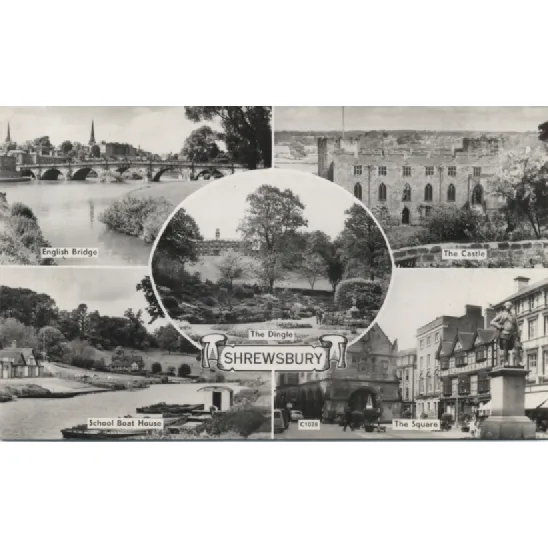
Shrewsbury — about 1950s — a postcard that, much like the town itself, refuses to be reduced to a single viewpoint and instead offers a carefully curated tour of its own respectability.
Here we have everything laid out with admirable efficiency: English Bridge doing its job with quiet competence; The Castle standing firm and faintly defensive; The Dingle providing greenery with purpose; The Square offering civilisation in brick and shopfront; and the School Boat House gently reminding you that water, when properly supervised, can also be recreational. All gathered together in one frame, as though Shrewsbury has decided to introduce itself properly rather than risk being misunderstood.
At the centre, The Dingle takes pride of place — a circular oasis of calm, framed like a medal the town has awarded itself for horticultural diligence. Trees, paths, and a sense of order prevail, suggesting that even nature here has agreed to behave sensibly. Around it, the supporting cast of views provides context: history, commerce, leisure — all present, all accounted for.
The architecture throughout carries that reassuringly solid tone of a place that has no intention of reinventing itself. Timbered buildings lean just enough to show character without causing concern. The castle remains where castles tend to remain. The bridge spans the river with the kind of reliability that makes you forget it’s even doing anything at all.
And then, of course, there’s the small matter of the stamp — used, present, and intriguingly described as “3D,” which adds a subtle layer of modernity to an otherwise thoroughly mid-century object. The postmark, however, has chosen to remain elusive, fading into ambiguity like a witness who prefers not to get involved. So while we know this card travelled, we don’t quite know when or how clearly it announced its departure. A mystery, but a polite one.
This postcard has done its duty. It was written, stamped, and sent — a small ambassador of Shrewsbury dispatched into the world with a message now secondary to the fact of its journey. Whatever was written on the back has become part of the object’s texture, a private note turned public artefact.
Condition: Used — properly and without apology. Writing present, stamp affixed, postmark indistinct but undeniably there, like a memory that refuses to sharpen. Edges softened by time, surfaces carrying the quiet evidence of having been handled, read, and kept.
Perfect for collectors of multi-view postcards, admirers of towns that know exactly what they are, or anyone who appreciates a piece of paper that has both travelled and endured. Display it somewhere thoughtful, and when asked about it, you can say, with measured confidence, “Shrewsbury, 1950s — all of it,” and let the collage quietly justify itself.
Keep browsing: See more Postcards-Photos books Other books by n/a
