


London SW One Inch Map
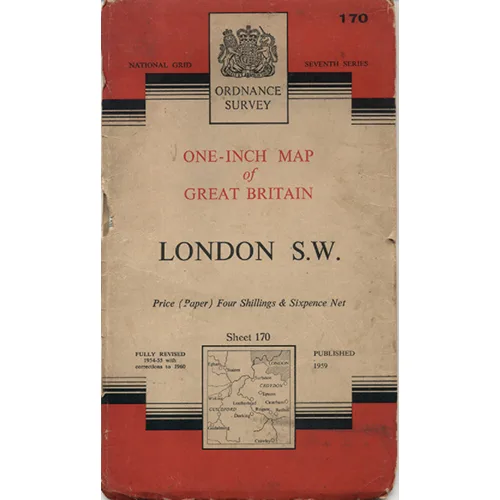
Publisher: Ordnance Survey
Format: Paperback
ISBN: none
Ah, London SW—the very epitome of that peculiar sub-genre of cartography where the lines between street names and existential dread blur as seamlessly as a foggy morning in the capital. This 1959 opus from the illustrious Ordnance Survey promises to guide you through the winding labyrinth of London’s suburbs, but don’t be surprised if you find yourself lost in a maze of nostalgia or perhaps a sudden craving for a cup of tea and a biscuit. The kind of tea that makes you feel both British and utterly bewildered by your own sense of direction.
This book isn’t just a collection of streets and postcodes; it’s a time capsule that invites the reader to ponder what all those pre-1960s Londoners were up to between the wars and before they discovered the joys of microwave meals. Did they ponder the same philosophical questions while waiting for the No. 37 bus that we do now, or was it all just rain-soaked, umbrella-wielding banter on the way to the nearest damp pub?
With a cover that has seen better days—and possibly a few more London drizzle showers than most of us would care to admit—this map is not so much an item of precise navigation as it is an artefact of cultural significance. The spine may creak like the oldest pub in Soho, but every crease and tear tells a story. Or perhaps it simply tells you which way to avoid walking when the skies open up. Either way, it’s a must-have for any serious collector of both geography and the absurd.
Inside, you will find meticulously crafted streets where the names may evoke a sense of familiarity, yet they are as slippery as an eel trying to escape a fishmonger. You might find landmarks that have long since changed, or perhaps they remain steadfast, stubbornly ignoring the relentless march of time. Will you find Camden Market bustling or a lone pigeon staring at you judgmentally as you consult the map for the umpteenth time? Only time will tell—or, indeed, this very book might hold the answers.
This delightful tome offers a treasure trove of features, including:
- A bewildering array of postcodes that seem to serve no purpose other than to confuse newcomers.
- Randomly placed piers that suggest some sort of aquatic adventure, though they are miles away from any water.
- Notable absence of landmarks like the London Eye, which could leave you wondering if it was ever considered ‘notable’ in 1959.
- A cartographic style that should remind you that sometimes, simpler is better—unless you’re lost.
- Possibly the most underwhelming map key you’ve ever encountered, leaving you to decipher symbols that look like they were drawn by a toddler.
It is entirely possible that London SW offers more questions than answers. What happened to all those communities? Are they still there, or have they been swallowed up by the relentless advance of gentrification? As you navigate the streets laid bare by Ordnance Survey, you will undoubtedly find yourself asking if you should have taken that left turn at the roundabout, or if you should indeed just resign yourself to a life of wandering aimlessly through the streets of South West London.
Condition: Used, but who isn’t these days? The pages might be yellowing like an old newspaper, the cover may sport more creases than a well-loved shirt, and the map itself may provide less guidance than you’d hoped. Yet isn’t that what gives it character? This book has seen life; it has been thumbed through by many a lost soul who dared to dream of understanding London without a GPS. And if you’re reading this, you too are likely on a quest for something, be it knowledge, adventure, or merely the best pint of bitter in town.
So why not take a chance on London SW? It’s more than a mere map; it’s a challenge, a riddle wrapped in an enigma, bound together with the threads of London’s rich history—however muddled that history may be. Because at the end of the day, who needs a comprehensive guide when you can have the eclectic wisdom of Crappy Old Books to lead the way?
Keep browsing: See more Maps books Other books by Ordnance Survey
