


Our Pricesless Heritage
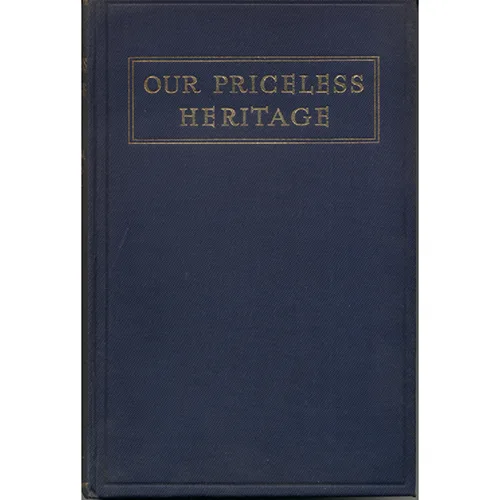
Publisher: Marshall, Morgam and Scott Ltd
ISBN: none
In a world rife with trinkets and treasures that could only be deemed “priceless” by their enthusiastic owners, Henry M. Woods boldly attempts to redefine the term in his 1940s masterpiece, "Our Priceless Heritage." Published by the illustrious Marshall, Morgam and Scott Ltd, whose name alone is a mouthful worthy of a tongue twister, this book promises to take you on an armchair journey through the annals of British culture, should you be brave enough to navigate its convoluted prose.
Imagine, if you will, a volume that dares to explore the uncharted depths of what makes British heritage "priceless." Woods, in his infinite wisdom—or perhaps with the fervent zeal of an overzealous historian—attempts to unearth the true value of everything from biscuit tins to the venerable art of queueing. Yes, that’s right, the very act of standing in line is examined as if it were the Mona Lisa of social customs, worthy of a place in the hallowed halls of human achievement. One could argue that such threads of thought reveal more about the human condition than the human condition itself.
As you leaf through the pages, you’ll encounter a treasure trove of subjects that conjure up a playful pantheon of British eccentricity. From the subtle art of tea-making to the nobility of the Sunday roast, Woods elicits an overwhelming sense of nostalgia, laced with a hint of absurdity. After all, who could forget the ceremonial importance of the annual garden party, where the stakes are as high as the cucumber sandwiches are low? This book claims to preserve all these rituals, elevating them to a status that could easily rival the crown jewels.
Of course, one cannot overlook the delightful irony that pervades the text. Woods writes with a fervour that suggests these quaint traditions are not only crucial but also somehow endangered, as if the British way of life were on the brink of extinction. His prose often extends into the realm of the overdramatic, where the fate of the nation hangs in the balance with every improper scone served at afternoon tea. One can’t help but chuckle at the melodrama of it all, as if he’s shouting from a soapbox in Trafalgar Square, imploring passersby to preserve the sanctity of the past.
Yet, lurking beneath the layers of whimsical commentary is a profound, albeit inadvertent, critique of modernity. Woods seems to suggest that in our rush toward innovation, we have forsaken the very elements that make our heritage "priceless." He is perhaps a noble knight battling the dragons of progress with his pen as a sword, valiantly defending the quaintness of yesteryears while simultaneously losing the plot. It’s a curious balancing act, one that leaves the reader simultaneously amused and bewildered.
To make the experience even more beguiling, the physical state of this book is a character unto itself. Condition: Each page carries the history of its previous owners, with the occasional coffee stain and a dog-eared corner that may tell tales of late-night readings or carelessly forgotten bookmarks. The spine is cracked, a testament to the enthusiasm of those who sought to uncover Woods’s musings. It is as if the book has lived a life of its own, absorbing the very essence of British life, complete with the dust of the past and the smell of old paper, a fragrance that one might describe as "vintage nostalgia."
So, if you are in the mood for a charmingly perplexing jaunt through the idiosyncrasies of British culture as viewed through the lens of a somewhat eccentric author, then "Our Priceless Heritage" might just be the ticket. Join Woods on this literary escapade where the mundane meets the profound, and prepare to question whether your own heritage is, in fact, as priceless as he insists. Just remember, you can find this quirky exploration of the past at Crappy Old Books, where we celebrate the delightful oddities of literature that might just change your perspective—or leave you scratching your head.
Keep browsing: See more Religion books Other books by Henry M Woods
