


The Black Moth
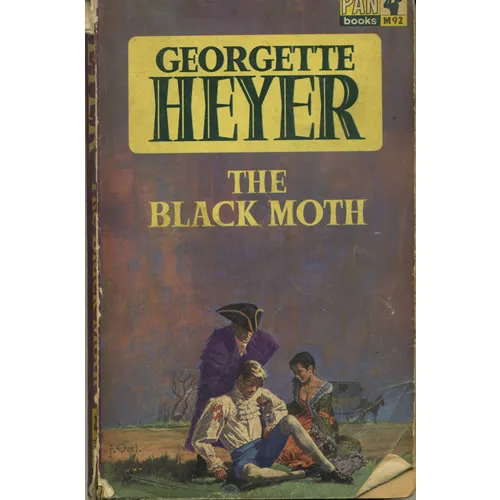
Publisher: Pan Books
Format: Paperback
ISBN: none
In the dimly lit corridors of early 20th-century literature, where the scent of worn paper mingles with the irony of aristocratic woes, Georgette Heyer’s "The Black Moth" emerges as a dapper anomaly. Originally published in 1921 and given a second life under the discerning eye of Pan Books in 1965, this novel flits between the raunchy realm of adventure and the hallowed halls of genteel society, much like a moth drawn to the flickering flames of a rather ill-advised candle. One can only wonder if the moth in question has a penchant for high tea or simply prefers the thrill of larceny.
Set in a time when men wore their mustaches with pride and women wore their social standings like badges of honour, our protagonist seems to embody this spirit, though perhaps with a smidge less decorum. The story, as it unfolds, invites readers to don their fanciest hats and pretend to sip imaginary Earl Grey while navigating the tumultuous waters of intrigue, romance, and the occasional scandal. It is indeed a tapestry woven with escapades that oscillate between the absurd and the charmingly ridiculous: a raucous ball here, a dashing duel there, all punctuated by clever repartee that would put even the sharpest wits to the test.
As you meander through the pages, expect to encounter an array of delightful characters who seem to have sprung from a tea-stained Victorian imagination. They are the sort who would likely take umbrage at a mispronounced soufflé yet might find themselves entangled in a plot thicker than the clotted cream served at afternoon tea. Not to mention the villainous types who, with moustaches twirling like the plot itself, are just waiting for their moment to be outwitted, outbidded, or outright ignored.
One cannot help but appreciate the audacity of a narrative that revels in its own absurdity. With tales of gallant highwaymen and charming rogues, "The Black Moth" offers an escape into a world where virtue is often overshadowed by the frivolity of fashion and folly. It is as if Heyer is winking at the reader, asking, “Can you believe this nonsense?” And of course, you can, because who wouldn’t want to indulge in a bit of anachronistic charm with a side of drama?
In a time when the book trade was still reeling from the aftermath of the Great War and the moral complexities that accompanied it, Heyer’s work stands as a playful nod to the absurdities of the upper crust. The themes of love, loyalty, and betrayal dance about like overzealous party guests who’ve had one too many sherries, imploring you to join their raucous soiree. You’ll find yourself chuckling at the sheer melodrama, as backstabbings become a mere hiccup in the grand theatre of life.
Condition: Used, no less, which adds a certain vintage charm to your reading experience. The pages might show signs of wear and tear, perhaps a smudge or a coffee ring that speaks to the vast and often tragic love affair between caffeine and literature. The spine is a little creaky, much like the characters within, and it may leave you wondering just how many hands have turned these pages before yours. It is a book that has lived, and like a well-travelled friend, it comes with its own tales of travels past.
So, prepare yourself for a delightful romp through a world where the stakes are high, and the fashion is even higher. Will our dashing hero manage to navigate the tumultuous seas of social propriety while still managing to look rather dapper? You’ll just have to read "The Black Moth" to find out, and perhaps reflect on what it means to be a true gentleman—or lady—in a world so hilariously chaotic.
Remember, at Crappy Old Books, we celebrate works like this one that have aged like fine wine, or perhaps more accurately, like a well-aged cheese—intriguing, a tad pungent, but utterly irresistible in the right company.
Keep browsing: See more Romance books Other books by Georgette Heyer
